
The Line Card Pulse (Fed Hike Risk, Dealer Closures & Wayfair Takes Share)
Read Time 9 mins
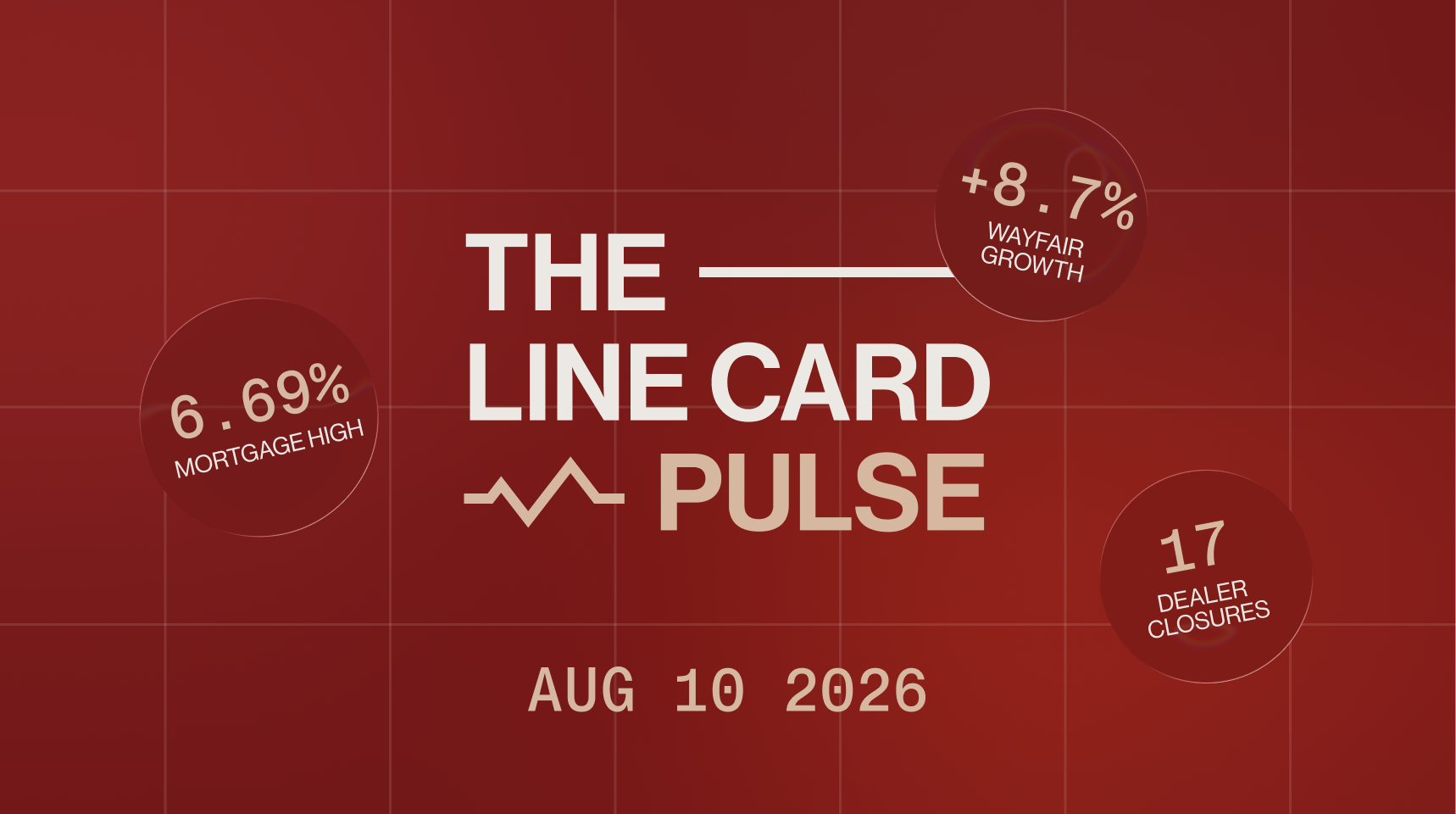
The Fed just sent its clearest signal yet that the next move is a hike, not a cut. Three regional presidents dissented in favor of raising rates at the July 29 FOMC — the most hawkish split in years. Mortgage rates hit 6.69% this week, a one-year high. Builder confidence has been below 40 for 15 consecutive months. Furniture retail was flat in June while every other retail category moved.
The channel is changing underneath the numbers. Seventeen dealers announced closure plans in Q1 alone — Georgia Furniture Mart, Country Willow, Greenbaum among them. Wayfair posted its best U.S. growth since the 2020 pandemic surge, up 8.7%, with its CFO explicitly crediting shoppers pulled away from traditional brick-and-mortar. The floor space is redistributing.
Two things cut against the gloom. Designers posted their strongest quarter in years on the Houzz barometer. And the IEEPA refund fight, representing $86 billion already disbursed with more contested in court, is being decided this week. Real cash, real timeline, real action required.
Fed Holds 9-3
On July 29, the FOMC voted 9-3 to hold rates at 3.50-3.75%. Cleveland's Beth Hammack, Minneapolis's Neel Kashkari, and Dallas's Lorie Logan all dissented in favor of an immediate hike — arguing inflation has stayed above the Fed's 2% target for more than five years. Three dissents for a hike is the most hawkish internal split in recent Fed history.
Rates are not coming down. The 9–3 split means the next move, if any, is a hike. Every planning assumption built on easing is now actively wrong, not just optimistic.
WHY IT MATTERS
- Three hawkish dissents means the September meeting is live for a hike. Update every dealer floor-plan program, consumer financing promotion, and inventory carrying-cost model to reflect the possibility of 3.75-4.00% Fed funds by Q4.
- Extended dating and floor-plan support programs are now a competitive differentiator in a market where dealers can't access cheap capital elsewhere. Brands that fund these programs hold floor space; brands that withdraw them lose it to whoever steps in.
- The September FOMC is 47 days away. Any rep still using rate-cut language in dealer conversations needs a new script today. The 9-3 dissent is the talking point: the Fed's own hawks are pushing for hikes, not cuts.
Sources: Federal Reserve FOMC Statement · CNBC
Mortgage Rates at One-Year High
Freddie Mac's PMMS for the week ending August 6 put the 30-year fixed rate at 6.69%, up from 6.66% the prior week and 6.63% a year ago. It is the highest rate since late July 2025. Builder confidence fell to 34 in July (from 36 in June), its 15th consecutive month below 40 — the longest such stretch since 2012. Thirty-seven percent of builders cut prices in July, average cut 6%, and 63% deployed sales incentives.
At 6.69%, the housing unlock that would drive new-home furnishing demand is not happening this year. Builders know it — 15 months of sub-40 confidence and price cuts confirm it.
WHY IT MATTERS
- The new-home furnishing cycle is frozen. Reps orienting call plans around housing turnover demand in this rate environment are calling the wrong accounts. Shift allocation toward renovation, refresh, replacement — and toward the designer channel serving those projects.
- Builder confidence at 34 with 37% cutting prices signals that the production builder channel is under margin pressure. Brands with builder programs should audit their key builder accounts for financial health before committing to spec-in investments.
- Single-family starts were essentially flat in June (-0.2% m/m) despite the headline 19% total starts jump, which was entirely multifamily. Multifamily furnishing timelines are longer and specification-driven, a signal to invest in contract and designer channel relationships, not sell-floor traffic.
Sources: Freddie Mac PMMS · NAHB Housing Market Index, · U.S. Census Bureau / HUD Housing Starts
17 Dealer Closures in Q1 Alone
Business of Home's Retail Watch column (July 23) counted 17 dealers announcing closure plans in Q1 2026 alone. Named closures include Georgia Furniture Mart (Atlanta), Country Willow, Grand Gallery, and Greenbaum Home Furnishings. eMarketer analyst Zak Stambor put furniture store sales down approximately 8% since 2022, with the first two months of 2026 down an additional 4.8% year-over-year.
Furniture retail was flat in June (Census Bureau MARTS, July 16) while total U.S. retail rose 0.2%. Flat is the new bad when fixed costs don't move.
WHY IT MATTERS
- 17 closures in one quarter means the dealer list your reps are calling is shorter than it was in January and getting shorter. Pull your AR aging report and cross-reference against known closure announcements before next week's territory reviews.
- Dealer closures concentrate demand into the surviving accounts. The retailers who are expanding are absorbing the volume that closed independents used to carry. Reweight rep time and support dollars toward the accounts that are growing, not toward relationships with dealers showing stress signals.
- Georgia Furniture Mart, Greenbaum, and Country Willow were established names. When names like those close, the market signal is structural, not cyclical. Build 2027 territory plans assuming another 10–15% independent dealer contraction, not stabilization.
Sources: Business of Home · U.S. Census Bureau MARTS
Wayfair Up 8.7%
Wayfair reported Q2 2026 U.S. revenue growth of 8.7% — its best performance since the 2020 pandemic surge. CFO Kate Gulliver told CNBC the gains are coming from shoppers "pulled away from traditional brick-and-mortar retail," explicitly, even as the housing market stays "stalled." Perigold, Wayfair's luxury line, grew over 35% in the quarter.
Wayfair is not benefiting from a market recovery. It is taking share from the dealers that are closing. Those are not the same thing — and the distinction matters for how brands respond.
WHY IT MATTERS
- Wayfair growing 8.7% in a flat market means it is absorbing volume from closing independents. If your brand is on Wayfair, that channel is likely growing. If you are not on Wayfair, the question is whether the volume your closing dealers carried is going to Wayfair or to a competitor who is on it.
- Perigold up 35% confirms the luxury e-commerce channel is gaining traction with high-AOV buyers. Brands with premium product that have avoided online channels on positioning grounds should revisit that decision — the buyer is there.
- The Wayfair share gain is structural, not cyclical. Independent dealers will not reopen when rates ease. Brands that build Wayfair as a strategic channel now will have that infrastructure when the market recovers; brands that wait will be playing catch-up.
Sources: CNBC
Designers Rebounding, Contractors Sliding
Houzz's Q3 2026 Pro Industry Barometer (fielded July 2–8) showed design firms' Recent Business Activity Indicator jumping to 62 in Q2, up from 48 in Q1 — with project inquiries rising to 62 (from 45) and new committed projects up to 63 (from 52). Construction firms moved the other direction: their same indicator slipped to 47 from 48. Designers are accelerating into Q3; contractors are softening.
The split is the signal. The specification-driven design channel is gaining momentum while the construction-driven channel weakens. For furniture and lighting brands, those two channels have very different buying patterns and timelines.
WHY IT MATTERS
- The designer channel is the strongest demand signal in this scan. Design firms at 62 on the activity index with committed projects up 11 points quarter-over-quarter means the specification pipeline is filling. Brands with strong trade programs are converting this; brands without them are watching it go to competitors.
- Project inquiries at 62 (up from 45) means designers are in active specification mode right now — building out the projects that convert to orders in Q3 and Q4. Fall High Point Market The contractor softness (47) signals that construction-dependent demand — new builds, major renovations — is losing steam. Brands whose pipeline depends heavily on new construction should model Q4 against a weaker contractor environment and shift emphasis toward the renovation and refresh projects that designers are specifying.
Sources: Houzz Q3 2026 Pro Industry Barometer
IEEPA Refund Fight Decided This Week in Court
CBP has disbursed over $86 billion in IEEPA tariff refunds through its CAPE portal since April. But importers whose customs entries were "finally liquidated" before the CAPE portal existed may not be covered — that specific question was argued before the U.S. Court of International Trade on August 6 in the V.O.S. Selections case. The ruling will determine whether finally liquidated entries require a separate CIT lawsuit or can still be recovered through CAPE.
Separately, at least nine furniture companies — including American Furniture Warehouse, Flexsteel, Culp, and Rugs America — have filed CIT complaints to recover Section 232 duties calculated on full customs value since April 2026. The tariff litigation calendar is crowded.
WHY IT MATTERS
- If your company has finally liquidated entries that predate the CAPE portal, consult trade counsel this week. The V.O.S. ruling will clarify whether those funds are recoverable through CAPE or require a separate lawsuit — and the window for protective filings may be closing.
- $86 billion disbursed means the refund process is real and moving. Brands that haven't filed Phase 2 CAPE declarations should do so immediately. Cash expected 60–90 days from filing — September and October receipts are still achievable for brands that act now.
- The nine furniture companies filing CIT complaints on Section 232 signal that the tariff recovery fight is not limited to IEEPA. If your brand has Section 232 exposure on full-customs-value calculations since April 2026, that is a separate recovery track worth evaluating with trade counsel.
Sources: Home Furnishings Association · Furniture Industry News
Read more insights
Smarter Selling Starts in Your Inbox
Get exclusive playbooks, guides, and case studies delivered monthly