Read Time 9 mins

Every manufacturer preparing for market — High Point Market runs October 17–21 this fall — works the same checklist. Catalog updated. Price list locked. Showroom merchandised. Samples shipped. New introductions photographed.
Then the doors open, and someone who doesn't work for you makes the sale.
Across furniture, lighting, and home décor, independent reps handle a large share of market floor coverage is handled by independent reps —1099 contractors who represent several brands across a territory, whether they are brought on for the show or carry the portfolio year-round. Figures from the Manufacturers’ Agents National Association put the typical rep firm at roughly six people selling for about ten principals. A rep working a market appointment may be responsible for five or six lines in a single conversation with a single buyer, and that conversation is often fifteen minutes long. We looked at the economics behind that model in Why Manufacturers Struggle with Independent Sales Reps.
Fifteen minutes. Six lines. One buyer with a list.
The stakes inside that appointment are rising. Coverage of the spring 2026 market pointed to flat-but-concentrated attendance: Business of Home reported that registered companies were down about 1% against the previous October while individual registrations fell only 0.1% — the firms that came brought larger teams. Home News Now heard the same read from executives: traffic felt lighter, but the buyers who showed up came to shop, and the conversations turned on how product makes a statement on the floor rather than on price. Fewer, more deliberate buyers means each appointment carries more weight — and less tolerance for a rep still finding their footing in your line.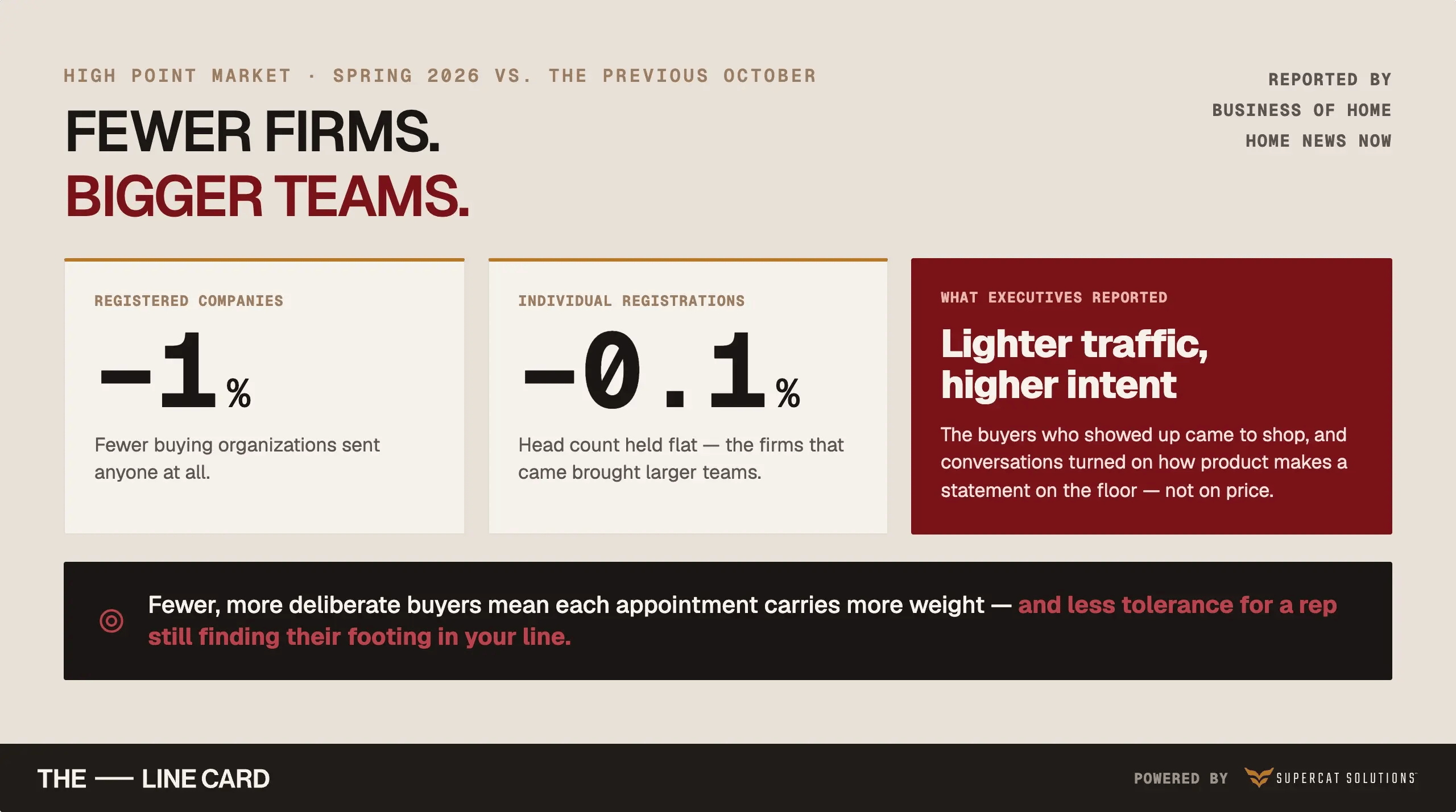
Nothing in that math rewards depth. It rewards whichever line the rep can open, explain, and route to a next step without hesitating. That is the line that gets pitched first, gets the most airtime, and gets written. Everything else becomes a business card and a “let me send you something.”
Why do brands compete for shelf space in the rep’s head?
Manufacturers tend to model rep behavior as a motivation problem. If the line isn’t selling, the assumption is commission structure, sample availability, or personal relationships.
Those factors matter. But they explain far less than the operational reality: an independent rep is running an inventory problem in their own memory, and your line is competing for space in it.
Consider what a rep actually needs to have loaded before a buyer sits down: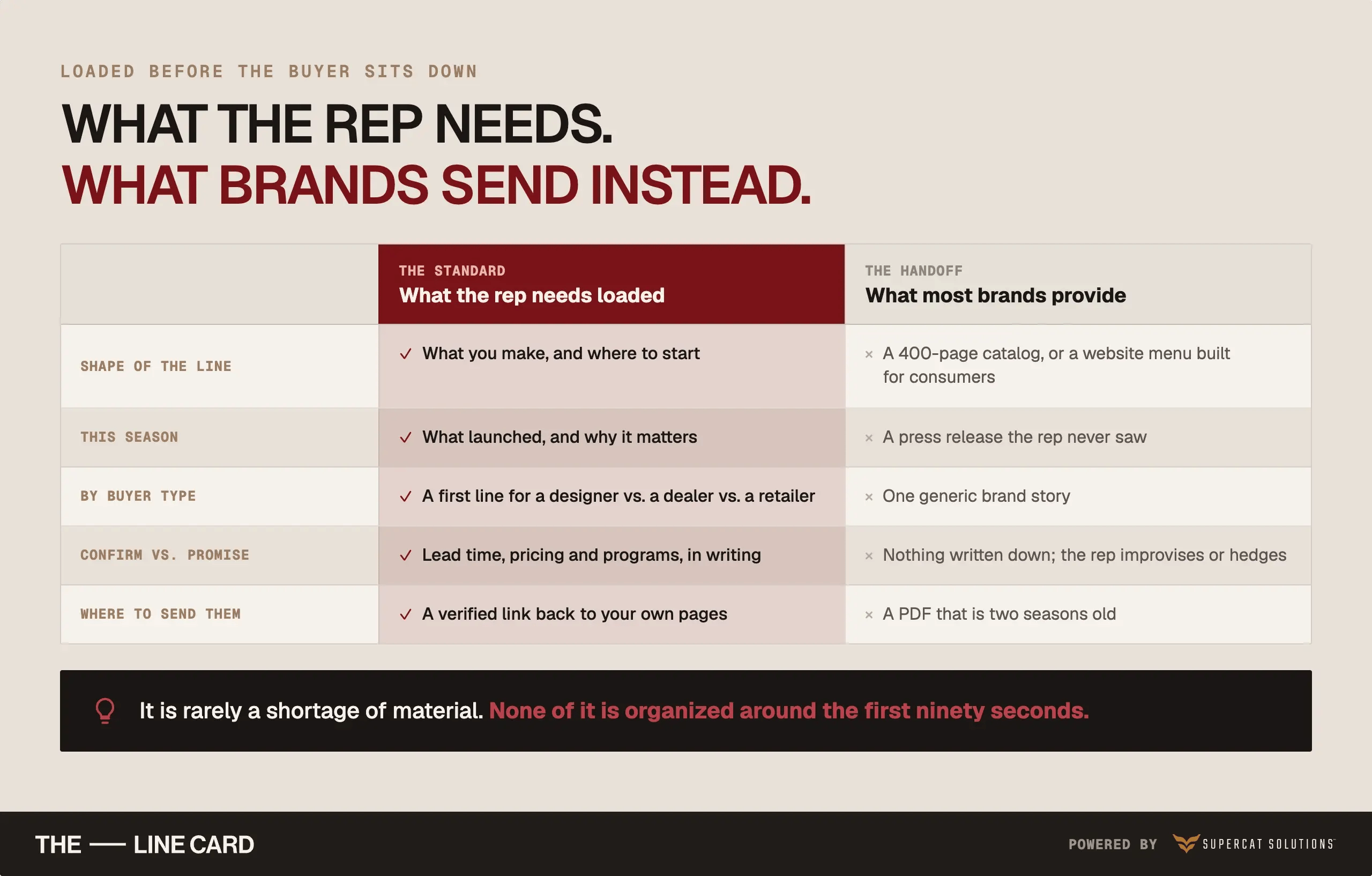
The failure is rarely a lack of material. Most brands have more content than the rep can use. The failure is that none of it is organized around the moment where selling actually happens — the first ninety seconds in front of a buyer.
A rep who has to reconstruct your line from a catalog will not do it in front of a customer. They will pivot to the line they already know cold.
Why does the easiest line win?
Three structural forces make this predictable, not accidental.
- Product complexity has outgrown informal onboarding. Furniture and lighting lines carry finishes, fabrics, mount types, configurable options, program pricing, and contract variants. A line that took an hour to learn ten years ago now takes a day. But the rep-onboarding ritual — a showroom walkthrough and a catalog handoff — has not changed. Complexity grew; the transfer mechanism didn’t. The same structural gap shows up in order entry and quoting, which we broke down in How Manual Sales Workflows Hurt B2B Manufacturers.
- Rep economics reward breadth, not depth. Carrying multiple lines is the rep’s own risk management. It increases customer reach and smooths seasonality. But it caps the attention any single brand can buy. No commission rate makes a rep fluent in a line they cannot summarize.
- Brand websites are built for the end consumer, not the field. The site that sells a sofa to a homeowner is organized by room and mood. The rep needs it organized by how buyers ask for things: a seating request, a storage need, an ambient lighting problem. The information exists. The routing does not.
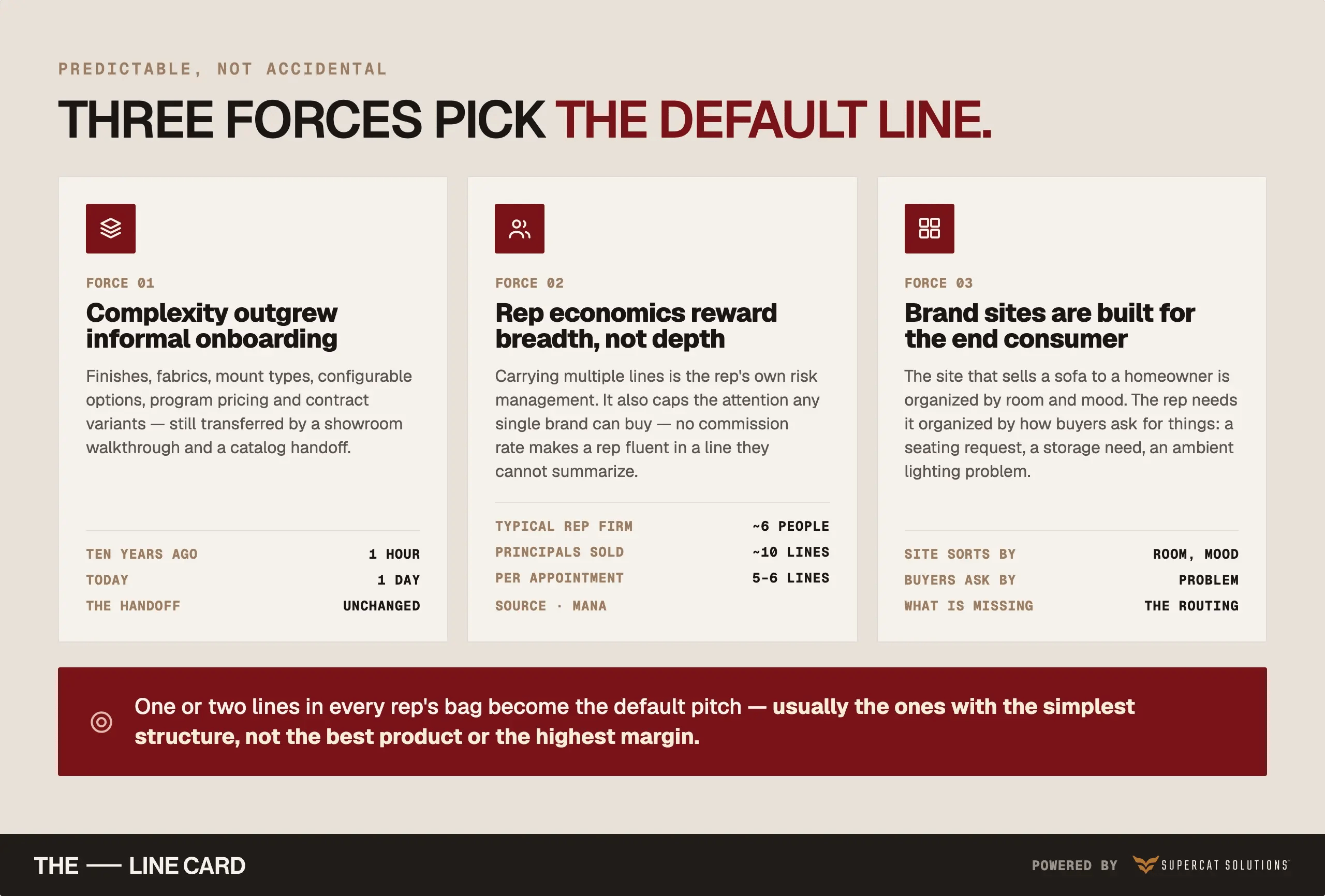
The result is a quiet selection effect. At every market, one or two lines in each rep’s bag become the default pitch — usually the ones with the simplest structure and the clearest openers, not the ones with the best product or the highest margin. Brands then read the order report and conclude that the market was soft.
Who pays for a rep who isn’t fluent in your line?
Manufacturers absorb the cost twice: once in the show investment, and again in the misdiagnosis. Weak market performance gets attributed to demand conditions or rep quality, when the actual variable was preparation.
Distributors and showrooms carrying multiple brands face the same dynamic on the floor year-round. Whichever line is easiest to present becomes the house recommendation by default.
Sales teams and territory managers lose their ability to coach. If reps are never given a common frame for the line, every rep sells a slightly different version of the brand, and inconsistency looks like individual performance variance.
Dealers and designers feel it as friction. Vague answers on lead time or program eligibility read as an unreliable partner, no matter how strong the operations behind the brand are.
Is more product information the same as usable product information?
Over the past decade, B2B tooling in this industry solved the storage problem. Product information management systems, digital product catalogs, and sales enablement platforms replaced binders and static PDFs. Mobile sales apps put the full catalog, live pricing, and quoting in a rep’s hands on the showroom floor. The capability set is now well understood; see Top 7 Sales App Features for Furniture & Lighting Brands for what that layer is expected to cover.
But access is not the same as fluency. A rep can hold a complete, perfectly accurate catalog on an iPad and still not know how to open a conversation about your line. Depth of data does not produce a first sentence.
This is where the industry is now shifting: from building the archive to building the entry point. Practically, that means brands are producing short, structured field briefs — the line at a glance, what launched this season, opening lines by buyer type, what to confirm rather than promise, and verified links back to the brand’s own pages for detail.
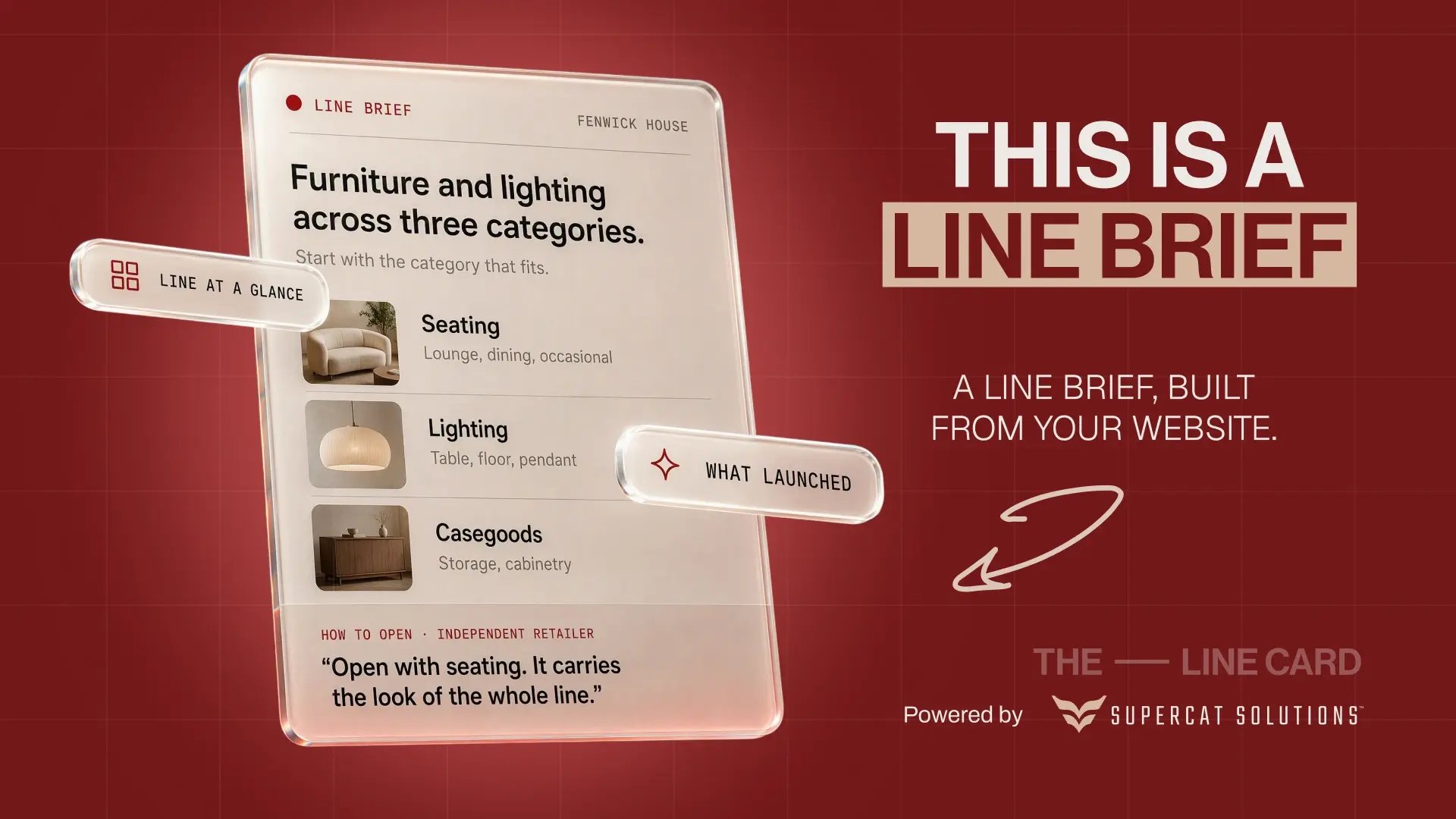
SuperCat’s Line Brief is one implementation of that idea: the brand sends its website, and the line is translated into a five-minute cheat sheet a rep can walk in with — a private link the sales leader can forward to the field before market. It sits in front of the platform layer rather than replacing it. The catalog and quoting tools handle the transaction; the brief handles the thirty seconds that decide whether a transaction gets started.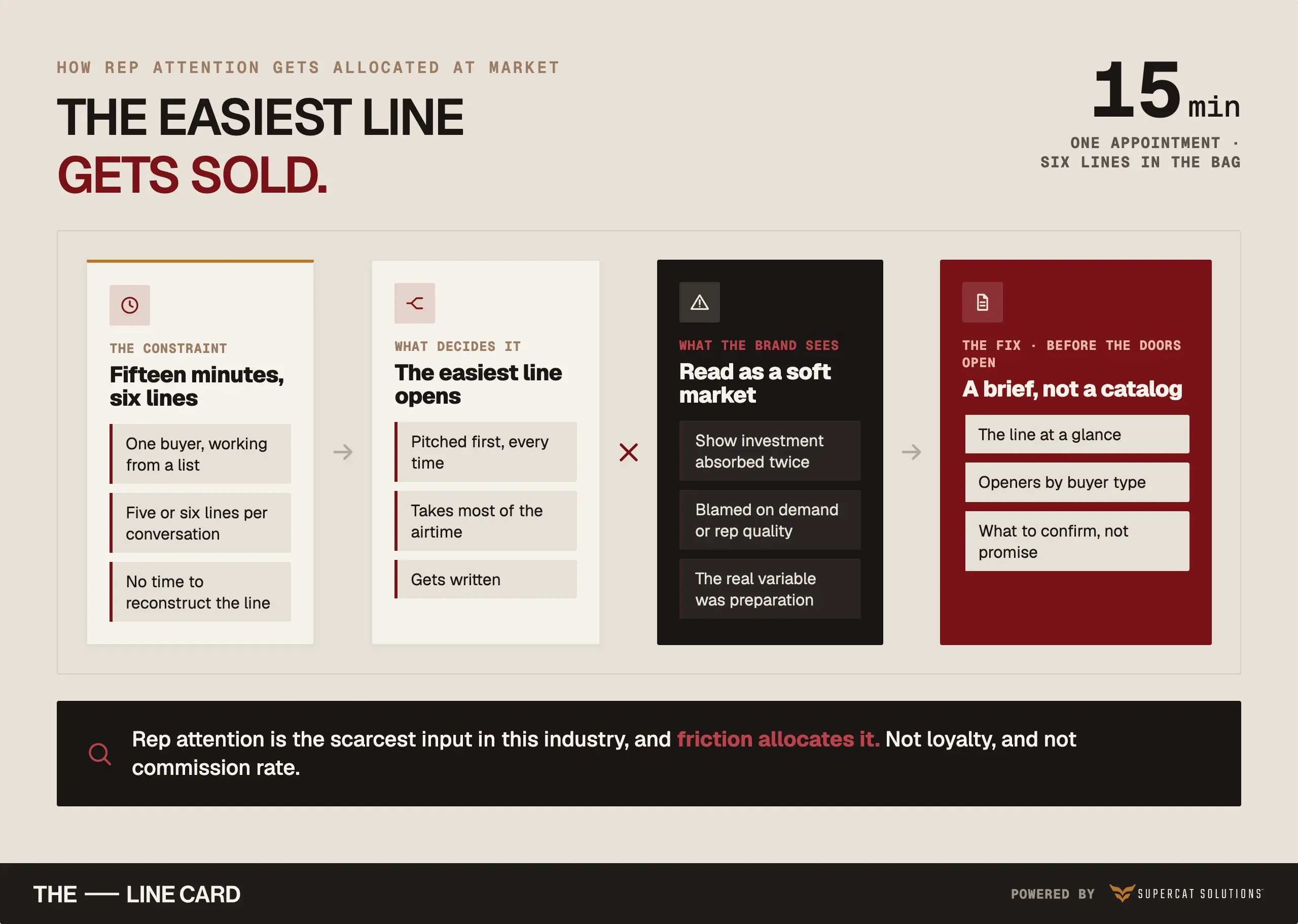
The broader point holds regardless of vendor. Product information management gets your data correct. Something else has to carry it.
What can sales leaders do before the doors open?
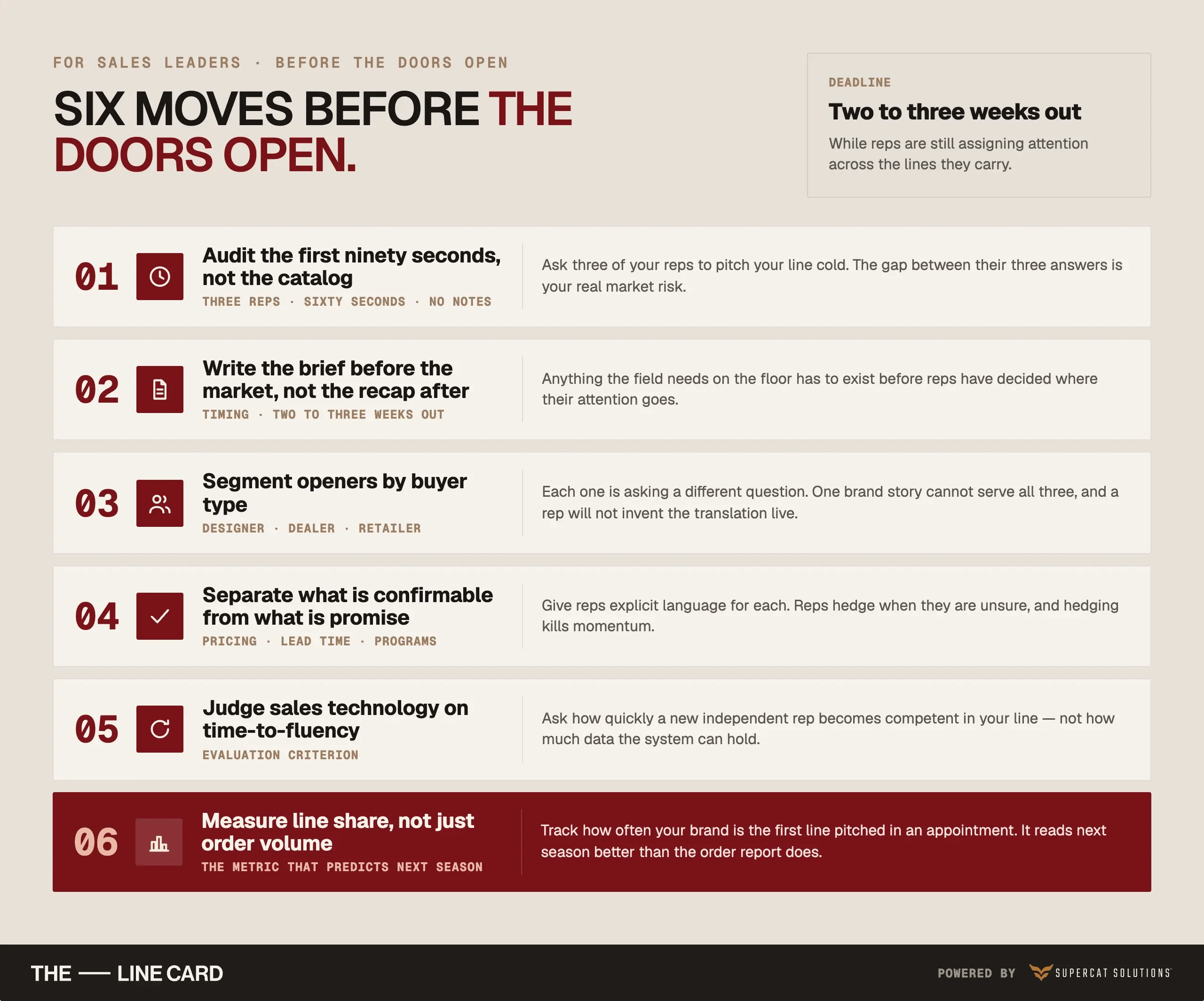
- Audit the first ninety seconds, not the catalog. Ask three of your reps to pitch your line cold, in a minute, without notes. The gap between their three answers is your real market risk.
- Write the brief before the market, not the recap after. Anything the field needs on the floor has to exist two to three weeks before the show, when reps are still assigning attention across their lines. Our market preparation guides cover the rest of the pre-show sequence.
- Segment openers by buyer type. A designer, a dealer, and a retailer are asking different questions. One brand story cannot serve all three, and a rep will not invent the translation live.
- Separate what is confirmable from what is promise. Give reps explicit language for pricing, lead time, and program eligibility. Reps hedge when they’re unsure, and hedging kills momentum.
- Judge sales technology on time-to-fluency. When evaluating quoting tools, mobile sales apps, or product information systems, ask how quickly a new independent rep becomes competent in your line — not just how much data the system can hold.
- Measure line share, not just order volume. Track how often your brand is the first line pitched in an appointment. That metric predicts next season better than the order report does.
What is the real lesson here?
Rep attention is the scarcest input in this industry, and friction allocates it. In a fifteen-minute appointment with six lines in the bag, the brand that is easiest to explain gets sold, and the rest get mentioned.
That is not a loyalty problem or a commission problem. It is an enablement problem, and it is solvable before the doors open. The manufacturers gaining ground at market are the ones who stopped treating the catalog as the handoff and started treating the rep’s first ninety seconds as a deliverable they own.