
Read Time 12 mins

Managing a lighting catalog with thousands of SKUs, countless variants, and intricate technical specifications is a daily operational challenge that directly impacts your sales, rep performance, and project success rates.
If your team spends hours updating spreadsheets, your reps constantly request the "latest" product information, or specification errors are eating into your margins, you're not alone. Most architectural and performance lighting manufacturers face the same challenge: product complexity has outgrown traditional catalog management methods.
Forward-thinking manufacturers are solving these problems with modern digital ecosystems that unify product data, sales tools, and customer portals into one connected system. This guide walks through both the strategy and the solution, showing you what's possible when catalog management evolves beyond PDFs and spreadsheets.
Why Lighting Catalogs Are Uniquely Complex
Unlike simple consumer products, lighting systems involve multiple layers of technical complexity:
Product variations multiply exponentially
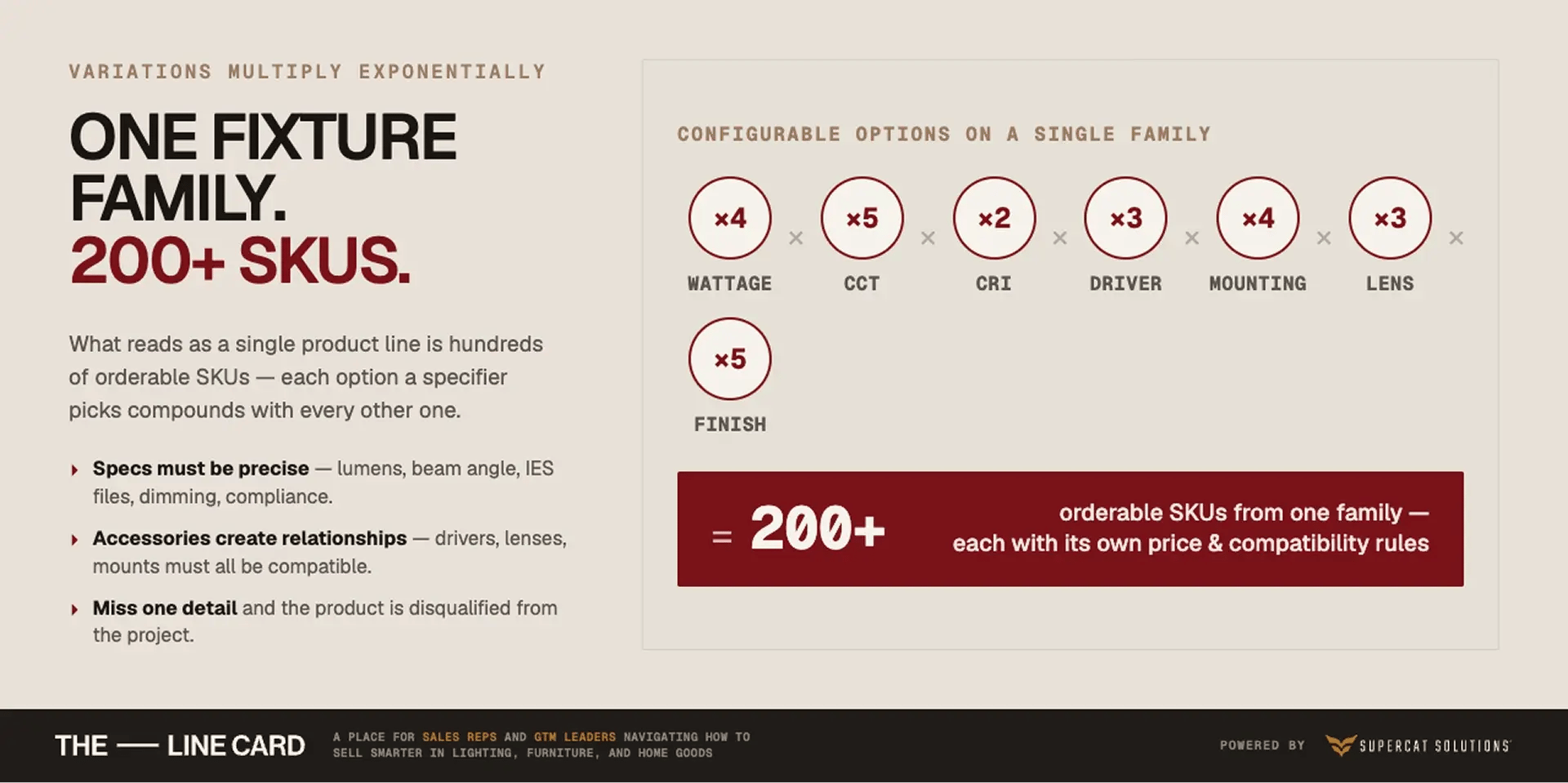
A single fixture family might include dozens of configurations based on wattage, color temperature (CCT), color rendering index (CRI), driver types, mounting options, lens choices, and finish options. What appears as one product line can easily represent 200+ orderable SKUs.
Technical specifications matter
Architects and lighting designers need precise data: lumens, beam angles, efficacy ratings, photometric files (IES), dimming compatibility, and energy compliance certifications. Missing or inaccurate technical specs can disqualify your product from a project.
Accessories and compatibility create relationships
Each fixture connects to specific drivers, mounting hardware, lenses, and control systems. Managing these relationships and communicating them clearly to specifiers and installers requires structured data, not just product descriptions.
Specification errors delay projects
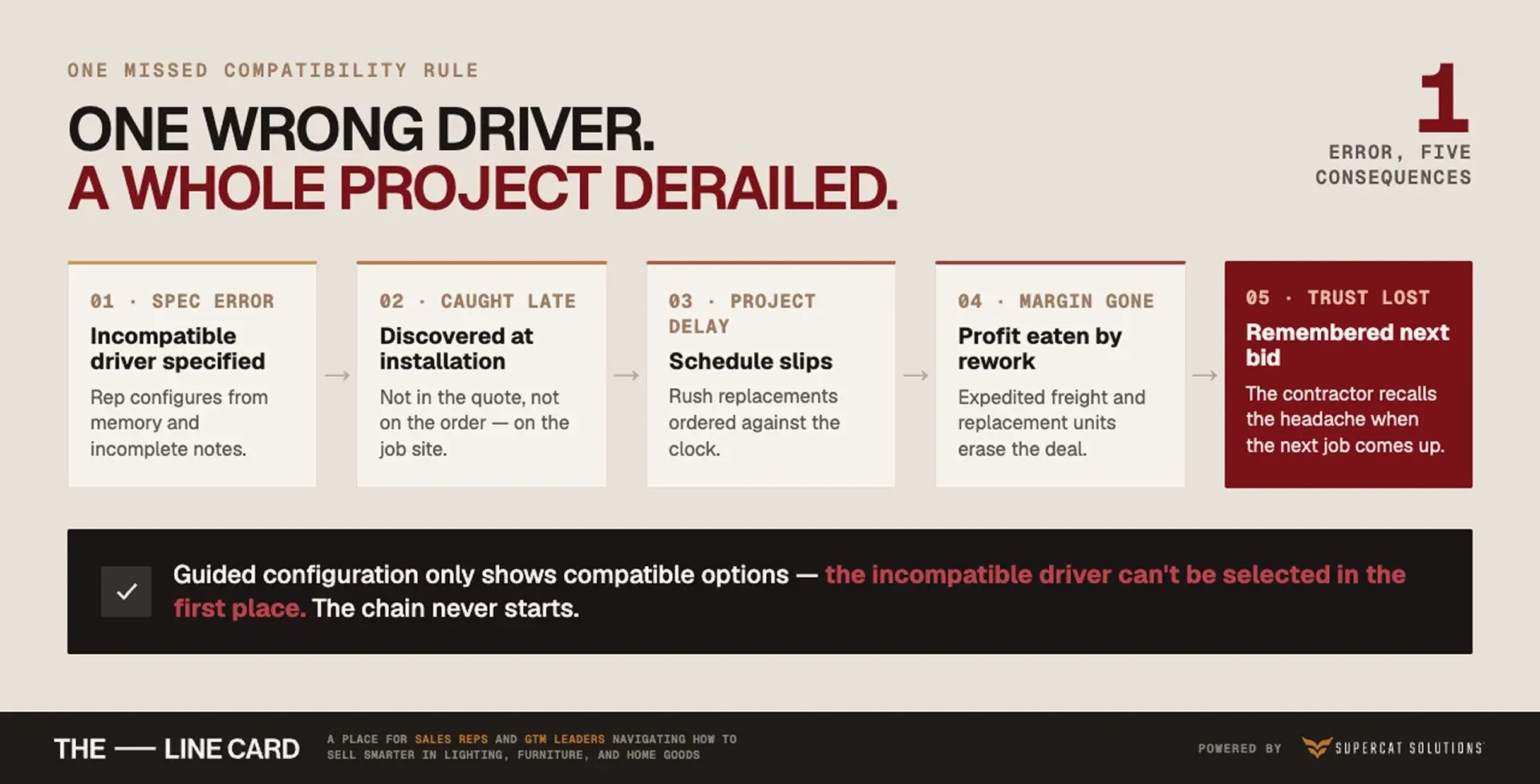
Your rep specifies a fixture with an incompatible driver. The error isn't caught until installation. The project delays, your margin disappears in rush replacements, and the contractor remembers the headache for the next bid.
Sales cycles extend unnecessarily
When reps can't quickly find the correct product configuration or verify current pricing, they delay quotes. Meanwhile, competitors with better tools move faster, often quoting the same project 2-3 days sooner.
Market expansion stalls
You want to enter new regions, but training new reps on thousands of SKUs without proper tools means months of ramp-up time and guaranteed confusion.
Customer experience suffers
Distributors can't access current pricing. Lighting designers struggle to find technical files. Contractors receive outdated lead times. Every interaction reveals the cracks in your catalog infrastructure.
The Modern Lighting Catalog Approach
Traditional catalog management relied on separate, disconnected systems: a database for product specs, spreadsheets for pricing, file servers for images, and email for distribution. Each update required manual work across multiple systems.
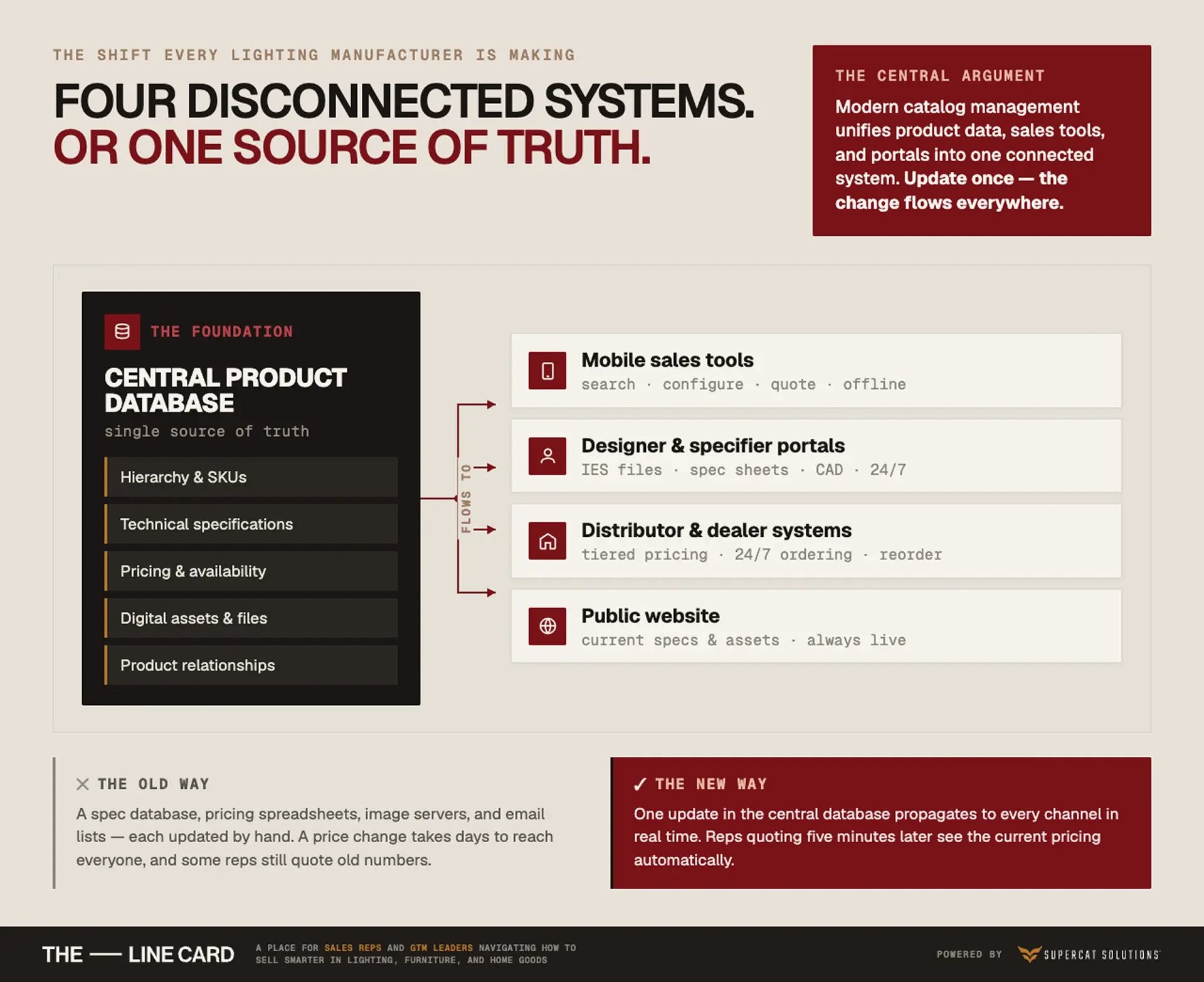
The modern approach unifies everything into a connected ecosystem where product data flows seamlessly from a central source to every touchpoint: sales tools, customer portals, distributor systems, and your public website.
The Four Pillars of Effective Lighting Catalog Management
- A centralized product database serves as your single source of truth. All product specifications, pricing, variants, images, technical files, and relationships live in one structured system. Update once, and the change flows everywhere automatically.
- Mobile sales tools empower your reps in the field. Whether at trade shows, in showrooms, or on job sites, reps access the complete catalog, configure complex products with guided workflows, generate accurate quotes instantly, and even work offline when connectivity is limited.
- Customer-facing portals extend your reach. Distributors, lighting designers, and contractors access current product information, pricing, and ordering capabilities 24/7 through web portals tailored to their specific needs and permission levels.
- Analytics and insights drive improvement. Track which products generate the most interest, which configurations cause confusion, how quickly reps respond to opportunities, and where your catalog needs refinement.
Building Your Lighting Catalog Foundation
The foundation of effective catalog management is eliminating multiple versions of product data. Every piece of information should originate from one authoritative source.
This central system becomes the master repository for:
- Product hierarchy and organization: Categories, families, series, base products, and specific SKUs.
- Complete technical specifications: Physical dimensions, optical performance, electrical characteristics, environmental ratings, and compliance certifications for every product variant.
- Pricing and availability: Current wholesale pricing, dealer tiers, volume discounts, lead times, and stock status are updated in real-time so quotes are always accurate.
- Digital assets: High-resolution images, photometric files, CAD drawings, installation instructions, spec sheets, and marketing materials.
- Product relationships: Compatible accessories, required components, alternative options, and complementary products that complete a lighting system.
When this foundation exists, updating a specification or changing a price becomes a single action that instantly propagates to every sales channel, every rep device, and every customer portal.
Organizing Your Lighting Catalog Around Sales Workflows
Structure your catalog to match how lighting actually gets specified and sold:
Application-based grouping
Beyond traditional categories, organize products by application: healthcare lighting, hospitality applications, outdoor architectural, and warehouse high-bay. This mirrors how designers and contractors search.
Configuration logic
Build guided selection flows that only show compatible options. If a customer selects a particular fixture, show only the drivers that work with it, only the lenses that fit, and only the compatible mounting options.
Customizable views
Your architectural sales reps need different product filtering than your performance lighting specialists. Distributors require different information than lighting designers: one catalog, multiple curated views.
Digital Lighting Catalog Access
Your reps spend their time in showrooms, at trade shows, and visiting project sites—not sitting at desks. They require catalog access that works in these environments.
Modern sales tools put your entire catalog on an iPad or tablet, with capabilities that transform how reps work:
Instant product search and filtering
Reps find products by application, specification, or project type in seconds—not by flipping through pages or asking the home office.
Guided product configuration
Complex products with dozens of options become manageable through step-by-step selection flows that prevent incompatible combinations and specification errors.
Real-time pricing and quoting
Generate accurate quotes on the spot with current pricing, appropriate customer discounts, and realistic lead times. No more, "I'll get back to you in a few days."
Offline functionality
At trade shows where Wi-Fi is unreliable or on job sites without connectivity, reps continue working with full catalog access. Everything syncs automatically when they're back online.
Personalized presentations
Create custom product collections for specific customers or projects. Show only what's relevant to this specifier's design aesthetic or budget parameters.
Extending Your Lighting Catalog to Sales Channels
Distributor and Dealer Portals
Your distribution partners need efficient access to current product information, pricing, and ordering capabilities. Giving them a branded web portal transforms the relationship.
Self-service product browsing reduces phone calls to your sales team. Distributors search your catalog, view current pricing for their tier, check lead times, and download technical files.
24/7 ordering capabilities capture business outside normal hours. Contractors working evening estimates can place orders immediately rather than waiting until morning when they might choose a competitor.
Order history and reordering simplify repeat business. Distributors can view past orders and reorder with a few clicks, reducing friction for your most profitable repeat orders of proven specifications.
Customer-specific pricing and permissions ensure everyone sees only what they should. Different distributors see different pricing. Some customers can order directly; others generate quotes for review. One portal, multiple configured experiences.
Supporting Lighting Designers and Specifiers With Catalog Access
Architects and lighting designers interact with your catalog differently than your sales reps do. They need tools that match their workflow.
Project-based organization lets designers save products for specific projects, compare options side-by-side, and build complete lighting packages rather than selecting individual fixtures.
Complete technical documentation in one place eliminates the need to hunt across your website for files. Every product page includes IES files, spec sheets, CAD blocks, installation details, and specification language, everything required for construction documents.
The specification export generates the three-part specification language that language designers require, formatted correctly for inclusion in project documentation. This small feature saves hours of manual work and increases the likelihood that your products get specified.
Solving Common Lighting Catalog Management Challenges
| Challenge | Traditional Process | Modern Solution |
|---|---|---|
| Price updates that take days to distribute | Update pricing in your ERP, export to Excel, update price lists, email to reps, regenerate PDFs, update website. By the time everyone has current pricing, days have passed, and some reps are still quoting old numbers. | Update pricing in your central product database once. The change instantly appears everywhere: mobile sales tools, customer portals, distributor systems, and your website. Reps who quote projects five minutes later see the current pricing automatically. |
| New product launches that drag on | product data to marketing, wait for descriptions. Send to IT for website updates. Create PDF catalog pages. Train reps in separate sessions. Email files to distributors. The process takes weeks, and the launch momentum dies. | Build new product data, specifications, pricing, and digital assets in a central system. When ready to launch, flip a switch and the new products appear everywhere simultaneously: rep devices, customer portals, distributor access, and your website. Training occurs through the tools themselves, which include built-in product information. |
| Rep onboarding that takes months | New reps receive catalog binders, price lists, and product training sessions. They spend months learning thousands of SKUs and still make specification errors because they're working from memory and incomplete notes. | New reps log into the mobile sales tool and have instant access to your complete catalog with guided configuration, built-in specifications, and visual product builders. They're productive in days rather than months because the tool prevents errors and prompts for required components. |
| Lost sales due to missing product information | Lighting designer visits your website, can't find the IES file they need, calls your sales rep, who's in another meeting, emails tech support, waits a day for a response. Meanwhile, they specify a competitor's fixture with easier access to data. | Designer visits your portal, searches for the fixture, sees all technical files organized clearly, downloads the IES file immediately, and continues their work. No delay, no phone calls, no lost sales. |
Measuring Lighting Catalog Performance and ROI
To understand whether your lighting catalog management and digital catalog optimization efforts are driving real business impact, track the following performance metrics. These KPIs connect catalog improvements directly to sales efficiency, accuracy, and revenue growth.
Quote generation speed
Measure the time from initial customer request to delivered quote. Faster quoting cycles enable sales teams to respond first, win more lighting projects, and shorten the overall sales cycle.
Specification error rate
Track the percentage of orders requiring corrections, rework, or rush replacements due to configuration or specification errors. Guided configuration and centralized product data significantly reduce these costly mistakes.
Sales rep productivity
Monitor how many quotes each sales rep generates per week. Modern digital catalogs and mobile sales tools increase output without longer work hours, effectively expanding sales capacity without additional headcount.
Customer engagement with quotes and products
Analyze quote open rates, time spent reviewing proposals, and product-level engagement. These insights reveal which lighting products attract the most interest and where sales content or pricing needs optimization.
Self-service adoption rate
Measure what percentage of routine orders, pricing checks, and product information requests are completed through customer portals instead of phone calls or emails. Higher self-service adoption lowers operational costs and improves the buyer experience.
Time to market for new lighting products
Track how long it takes to move from product readiness to active quoting by the sales team. Faster digital launches translate directly into quicker revenue realization and stronger competitive positioning.
What's Possible With Modern Lighting Catalog Management
The manufacturers who've modernized their catalog management report transformative results:
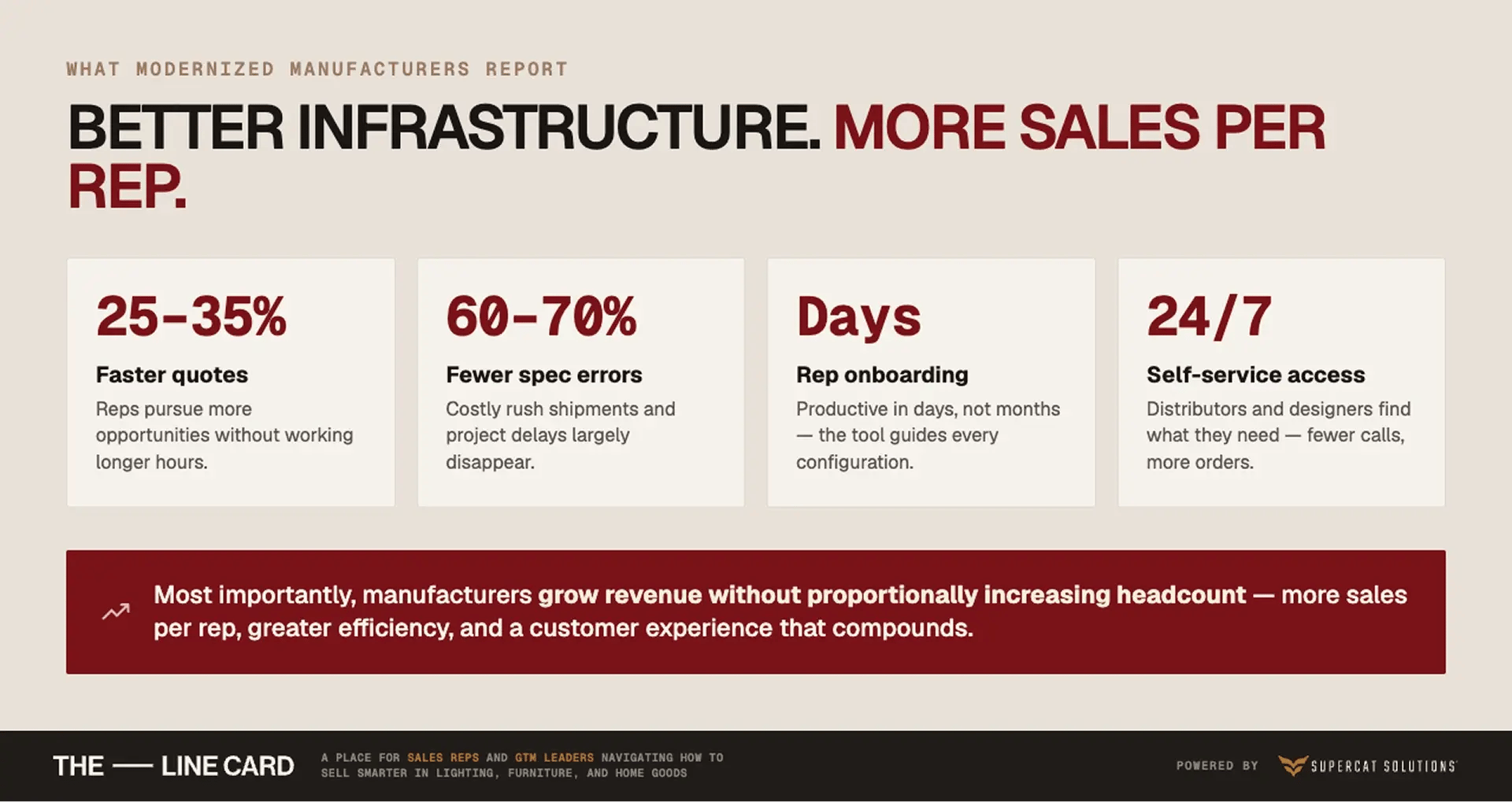
Reps quote projects 25-35% faster, allowing them to pursue more opportunities without working longer hours. Specification errors drop dramatically, sometimes by 60-70%, eliminating costly rush shipments and project delays.
New reps reach productivity in days rather than months because tools guide them through complex configurations. Distributors and designers access information 24/7, reducing phone calls and capturing business outside normal hours.
Most importantly, these manufacturers grow revenue without proportionally increasing headcount. Better catalog infrastructure means more sales per rep, greater operational efficiency, and a better customer experience.