
Read Time 10 mins
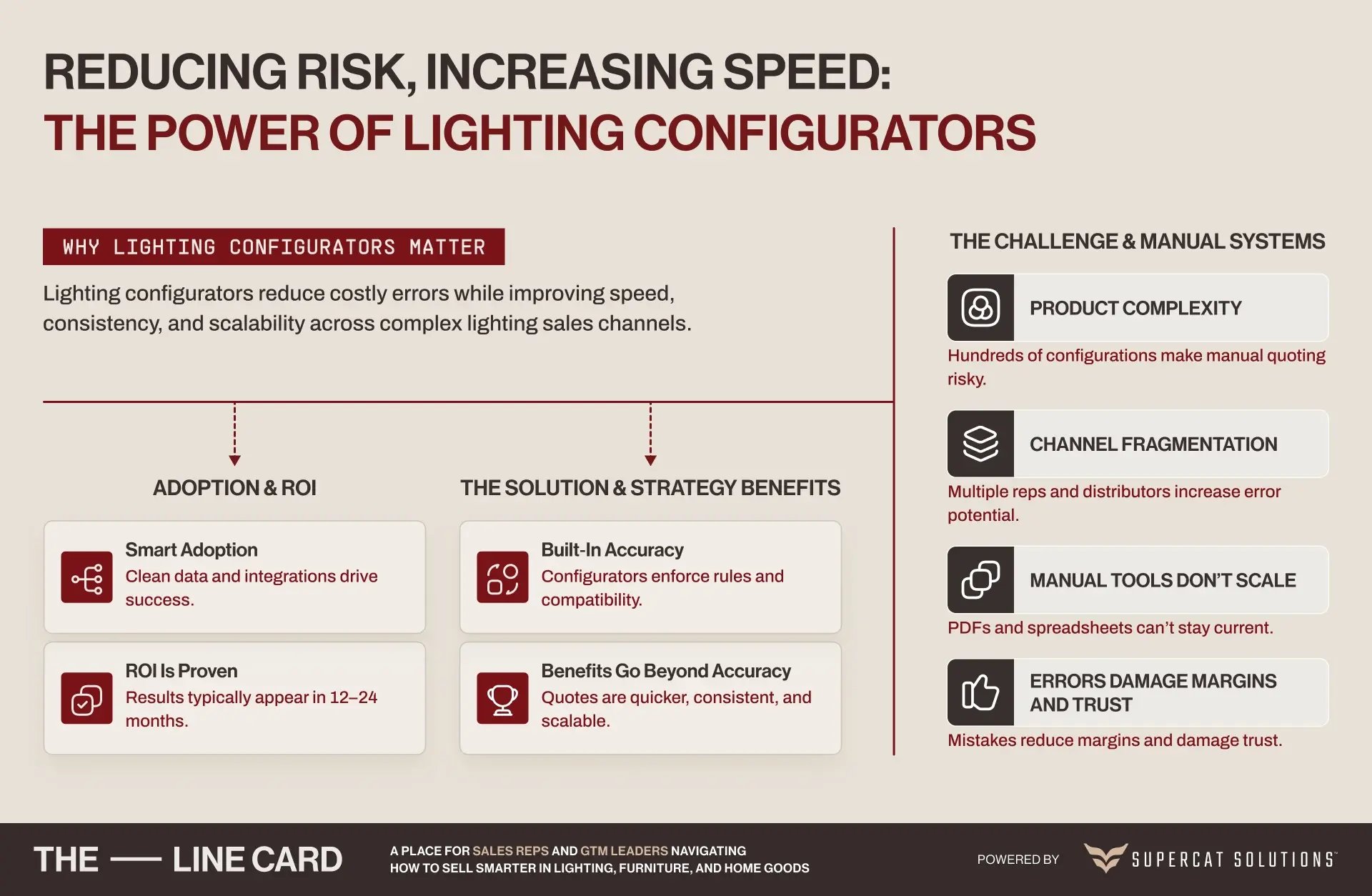
A single specification error can cost thousands of dollars and damage relationships with architects, contractors, and distributors that took years to build. When a rep quotes the wrong driver for a fixture or misconfigures an optical package, the consequences ripple through the entire project, including rushed corrections, expedited shipping, delayed installations, and frustrated specifiers who question your reliability.
Why Quoting Errors Are So Common
The complexity of modern lighting specification creates countless opportunities for error. Unlike simple products, architectural lighting systems require precise coordination between multiple interdependent components with technical specifications that must align perfectly.
The Complexity Problem
Your product line likely includes dozens of fixture families, each available with multiple wattages, color temperatures, CRI options, driver types, mounting configurations, optics, and finishes. A single recessed downlight might have 200+ valid configurations when you account for all variables.
Sales reps working across multiple territories must remember which drivers work with which fixtures, whether a specific lens fits a particular housing, and how emergency battery packs integrate with dimming systems. Even experienced reps struggle to maintain this level of product knowledge across your entire catalog, especially when you introduce new products or phase out older ones.
The problem intensifies when reps represent multiple manufacturers. A lighting agent managing five brands effectively must maintain knowledge of five distinct product ecosystems, each with unique rules and compatibility matrices.
Channel Complexity Amplifies Risk
Your sales model compounds the challenge. Unlike direct sales, where you control training, you work through independent reps, regional agents, and distributors with varying levels of product familiarity.
Manual Processes Can't Scale
Many manufacturers still rely on PDF catalogs, Excel price lists, and tribal knowledge. Reps flip through specification sheets, cross-reference compatibility charts, and manually calculate project quantities under tight deadline pressure.
When your product manager updates a specification or pricing, those changes must cascade across multiple documents, websites, and rep portals. The lag between "we changed something" and "everyone knows about it" creates a window where quotes reflect outdated information.
The True Cost of Specification Errors
Quoting mistakes impact your business beyond immediate correction costs. Underpriced quotes erode margins on projects spanning months or years. Overpriced quotes lose to competitors who quoted correctly.
Orders based on wrong specifications trigger change orders, expedited shipping, and restocking fees. Your operations team spends hours managing exceptions that accurate quotes would have prevented.
When a contractor discovers during installation that specified components don't work together, you've damaged trust in ways that spreadsheets can't capture. Architects who specify your products expect reliability. Repeated errors push them toward competitors whose quotes they can trust.
Your reps lose credibility with their networks. A distributor receiving customer complaints about your specifications may quietly de-emphasize your products. These relationship costs compound over time, gradually eroding market position.
How Lighting Configurators Systematically Eliminate Errors
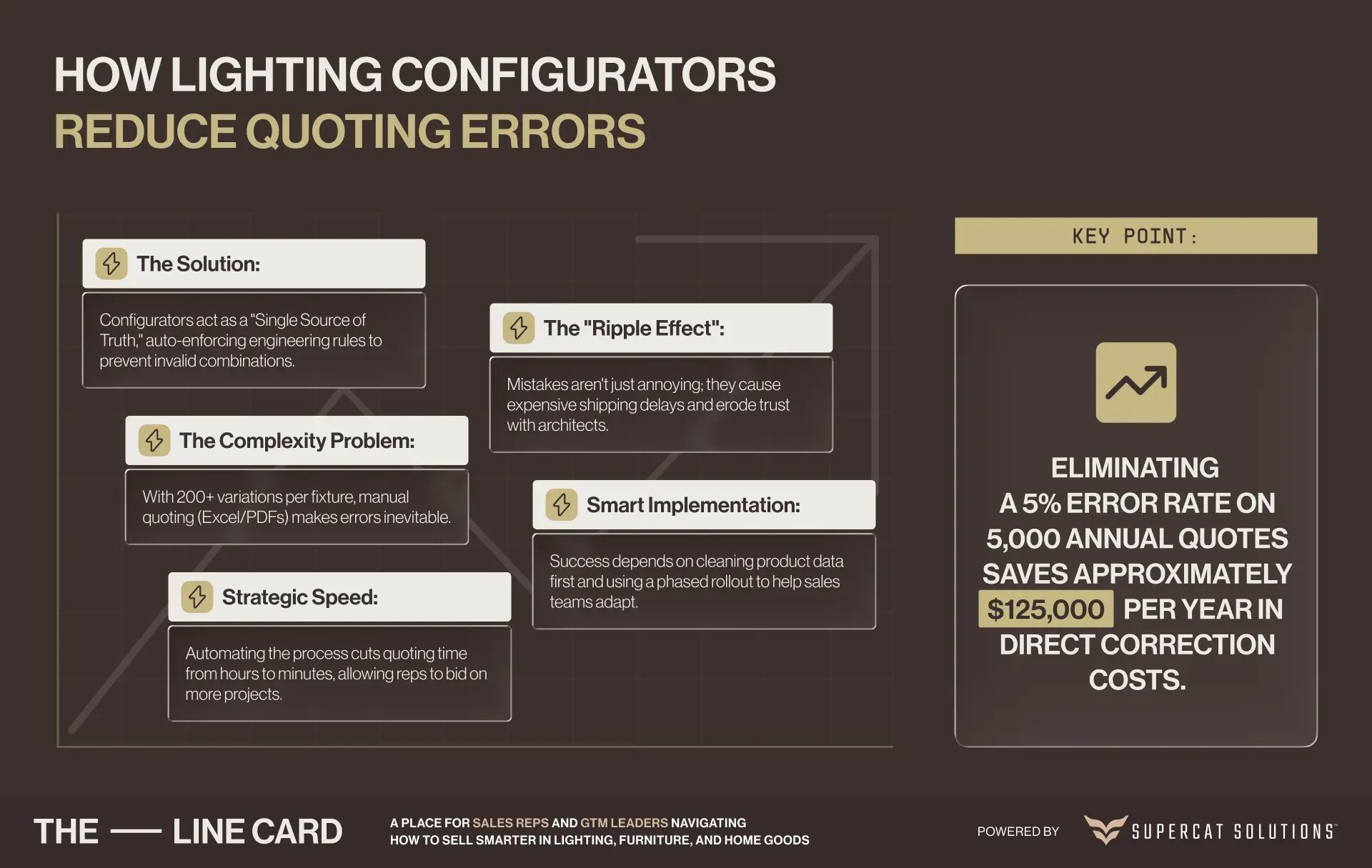
Configurators prevent entire categories of mistakes by encoding your product knowledge directly into the quoting process.
Real-Time Compatibility Enforcement
The most powerful error prevention mechanism is automated compatibility checking. The configurator maintains comprehensive rules about which components work together based on electrical requirements, physical dimensions, control compatibility, and regulatory compliance.
Single Source of Truth for Product Data
Lighting configurators connect directly to your master product database, eliminating version-control issues that plague PDF catalogs and Excel spreadsheets. When your product manager updates a specification, that change is reflected immediately in every quote generated by the configurator.
This centralized data management solves the "which version is current?" problem. Reps no longer use outdated price lists stored on their laptops. Distributors don't quote from six-month-old catalogs. Everyone accesses the same accurate, current information.
Integration with your ERP system ensures pricing reflects current costs, agreed-upon margins, and customer-specific discounts. The configurator automatically applies volume breaks, promotional pricing, and special agreements without manual intervention.
Guided Workflows That Embed Expertise
Lighting configurators transform tacit knowledge held by your senior team into structured processes that any rep can follow. The system guides users through logical selection sequences, prompting for all required decisions and preventing incomplete specifications.
For a recessed architectural downlight project, the configurator might first ask about the application type, then filter for appropriate fixture families, present compatible wattage options based on the ceiling plenum depth, and finally offer suitable optics for the specified task. Each step narrows subsequent options based on prior selections.
This guided selling approach is particularly valuable for newer reps or distributors who lack deep product knowledge. They can generate accurate quotes by following the workflow, with the system serving as an always-available expert.
Beyond Error Reduction: Strategic Benefits
While preventing specification mistakes is the primary value driver, lighting configurators deliver operational advantages that strengthen your competitive position.
Dramatically Faster Quote Generation
Time-to-quote matters in competitive markets. Configurators compress quote generation from hours to minutes. Your reps spend less time hunting through catalogs and more time building relationships and providing technical consultation.
Faster quoting increases the number of opportunities each rep can pursue, effectively expanding sales capacity without adding headcount.
Consistent Brand Experience
When different reps quote the same project differently, customers question your professionalism. Lighting configurators ensure consistency. Every user follows the same process, considers the same options, and generates quotes in the same format.
Empowered Self-Service for Distributors
Many manufacturers provide configurator access directly to distributors, enabling them to generate accurate quotes without waiting for rep support. This self-service capability is valuable for straightforward replacement projects or simple installations.
Distributors appreciate the autonomy to serve customers quickly. Your reps appreciate fewer interruptions for routine quotes, allowing them to focus on complex specification opportunities.
Actionable Business Intelligence
Configurator usage generates rich data about customer behavior, popular configurations, and market trends. You can identify which product combinations are most commonly specified, where users struggle in the selection process, and which features drive purchasing decisions.
This intelligence informs product development priorities. Sales leadership gains visibility into rep activity and quoting patterns, enabling coaching and strategic planning based on facts rather than impressions.
Selecting the Right Lighting Configurators
Not all configurator solutions deliver equal value for architectural and performance lighting manufacturers. The right choice depends on your product complexity, sales model, and growth trajectory.
Support for Complex SKUs
The system should accommodate trims, housings, optics, accessories, emergency options, controls, and multi-part assemblies. Lighting products involve layered configurations, and the tool must reflect this complexity.
ERP and CRM Integration
Accurate quoting requires real-time pricing, customer-specific terms, discount structures, and availability. Integration eliminates outdated spreadsheets and manual corrections.
Centralized Product Data
All specs, compatibility rules, and updates should flow from a single product database, ensuring every user quotes from the most current information.
Flexibility
A robust API layer supports custom workflows, PIM/DAM connections, and automated catalog updates.
Optional Offline Use
Low-connectivity environments benefit from basic offline capabilities, especially during market events or field visits.
Role-Based Permissions
Different users (reps, distributors, inside sales) require different product views and pricing tiers. Permissions maintain accuracy and keep each channel aligned.
Implementing Lighting Configurators
Technology alone doesn't solve problems. Successful implementation requires thoughtful planning, clean data, and effective change management.
Get Your Product Data House in Order
Before implementation, invest time in cleaning and validating your product information. Document all compatibility rules, component relationships, and business logic systematically.
Involve your product management team, engineering staff, and most experienced reps in defining configuration rules. Establish clear data governance processes for maintaining accuracy as products evolve.
Plan for Change Management
Your reps have worked with PDF catalogs for years. Some will embrace the configurator immediately. Others will resist change, especially if they're successful with current methods.
Address resistance proactively by demonstrating clear benefits. Show how the configurator reduces workload, accelerates quoting, and prevents embarrassing errors. Share success stories from early adopters who closed business faster.
Provide comprehensive training that covers not only how to use the tool but also why it benefits them specifically. Role-specific training is more effective than generic sessions.
Roll Out Strategically
Avoid big-bang implementations across your entire channel simultaneously. Start with a pilot group of friendly reps who will provide constructive feedback. Learn from their experience before expanding to your whole sales network.
Consider phased rollout by product line. Begin with your most commonly quoted products or your newest product family, where reps lack established habits.
Calculating ROI
Configurator investments require approval from leadership, who need clear justification. Building a compelling business case requires quantifying both hard costs and strategic benefits.
Direct Cost Savings
Calculate current error costs by tracking change order processing, expedited shipping charges, restocking fees, customer service time, and sales operations time spent correcting quotes.
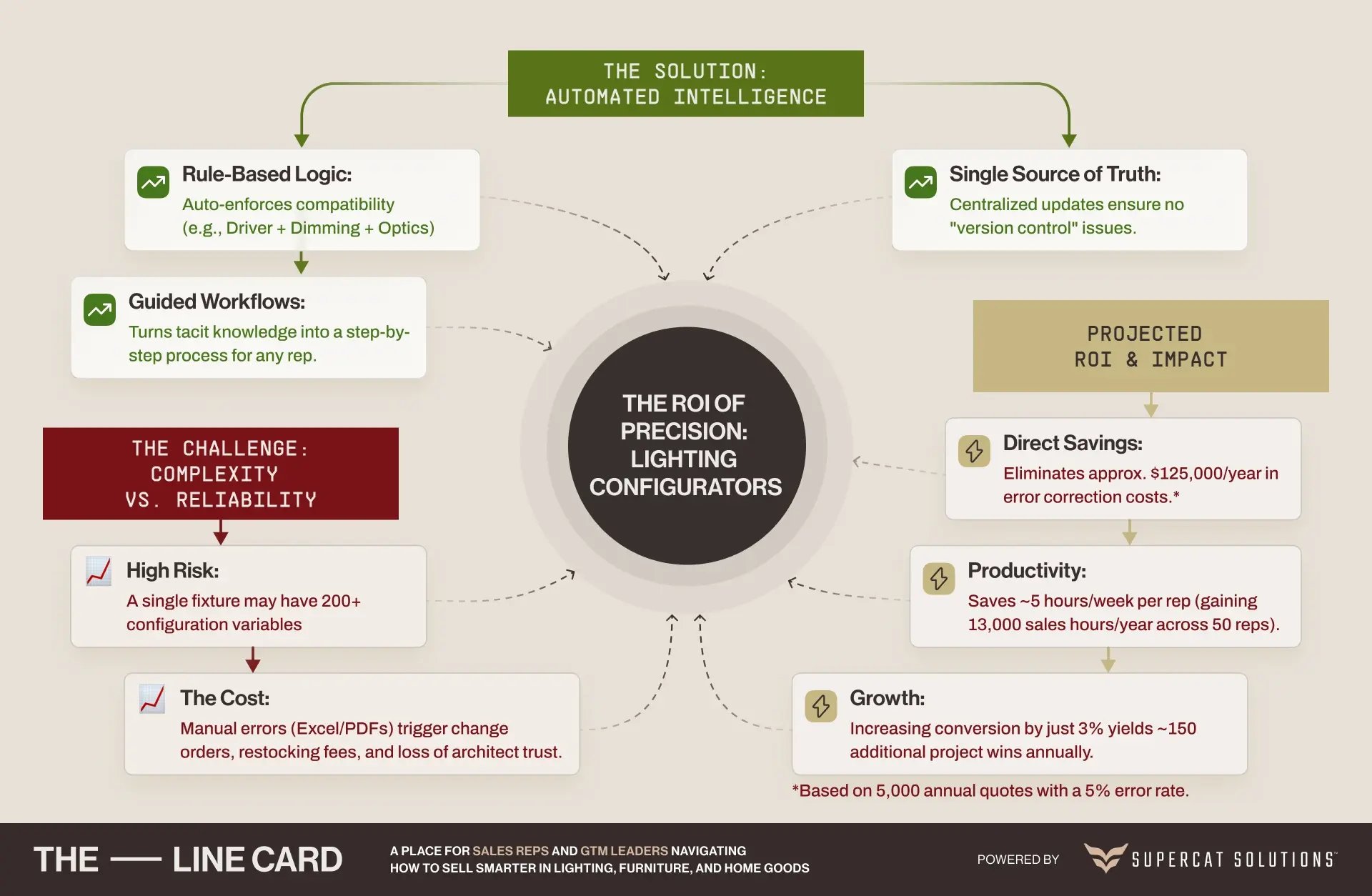
Even modest error rates generate substantial costs. If you process 5,000 quotes annually with a 5% error rate requiring an average of $500 to correct, that's $125,000 in direct annual costs that configurators essentially eliminate.
Productivity Gains
Measure current quote-generation time and estimate realistic time savings from configurator use. If your 50 reps each save 5 hours per week on quoting tasks, that's 13,000 hours annually, equivalent to 6+ full-time employees' worth of capacity.
This capacity enables growth without proportional increases in headcount.
Revenue Impact
More accurate quotes improve win rates. If configurators increase your quote-to-order conversion from 25% to 28%, that 3-percentage-point improvement on 5,000 annual quotes means 150 additional won projects.
Most manufacturers achieve positive ROI within 12-24 months when considering all benefits.