
Read Time 10 mins
Build vs. buy is the choice between building your own sales tool and licensing a category-built one. Building can also mean extending a website, ERP module, or configurator you already own. In furniture and lighting, the choice is harder than in most B2B verticals, because the hard part is not the interface. It is the product data underneath it.
A typical decorative lighting or upholstery line carries finish and fabric matrices, grade-based pricing, made-to-order configurations, seasonal introductions, customer-specific price codes, territory rules, and a field team that has to quote accurately on a show floor with no reliable signal. Anything that handles all of that is a pricing engine, a product information management layer, a configurator, an offline sync system, and an order pipeline.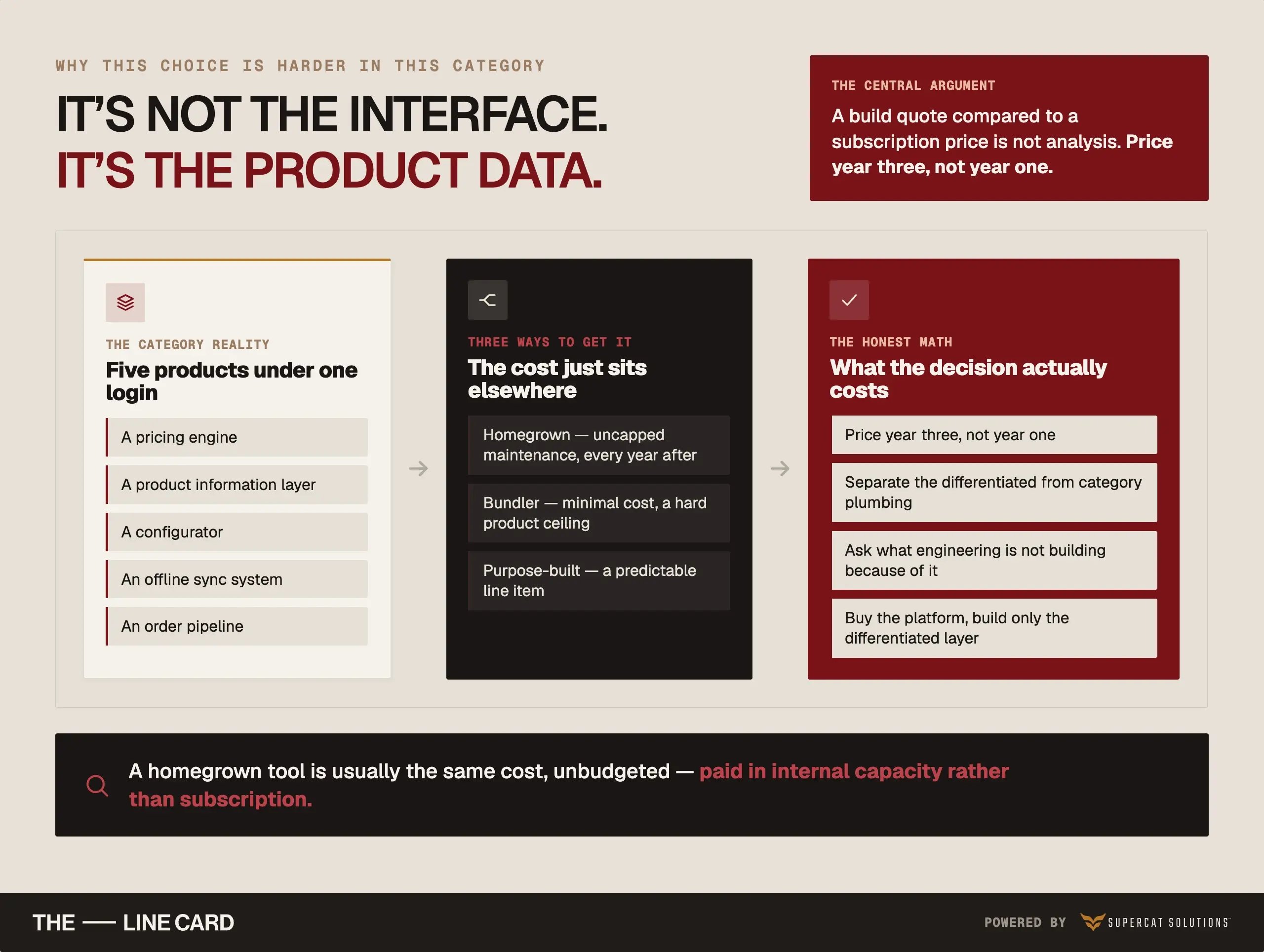
How homegrown tools and purpose-built platforms compare on total cost of ownership
The three options differ less on price than on where the cost sits and who absorbs it. A homegrown tool front-loads cost into a build and then spreads an uncapped maintenance liability across every year that follows. A bundler minimizes both but caps what the product can ever do. A purpose-built platform converts the liability into a predictable line item.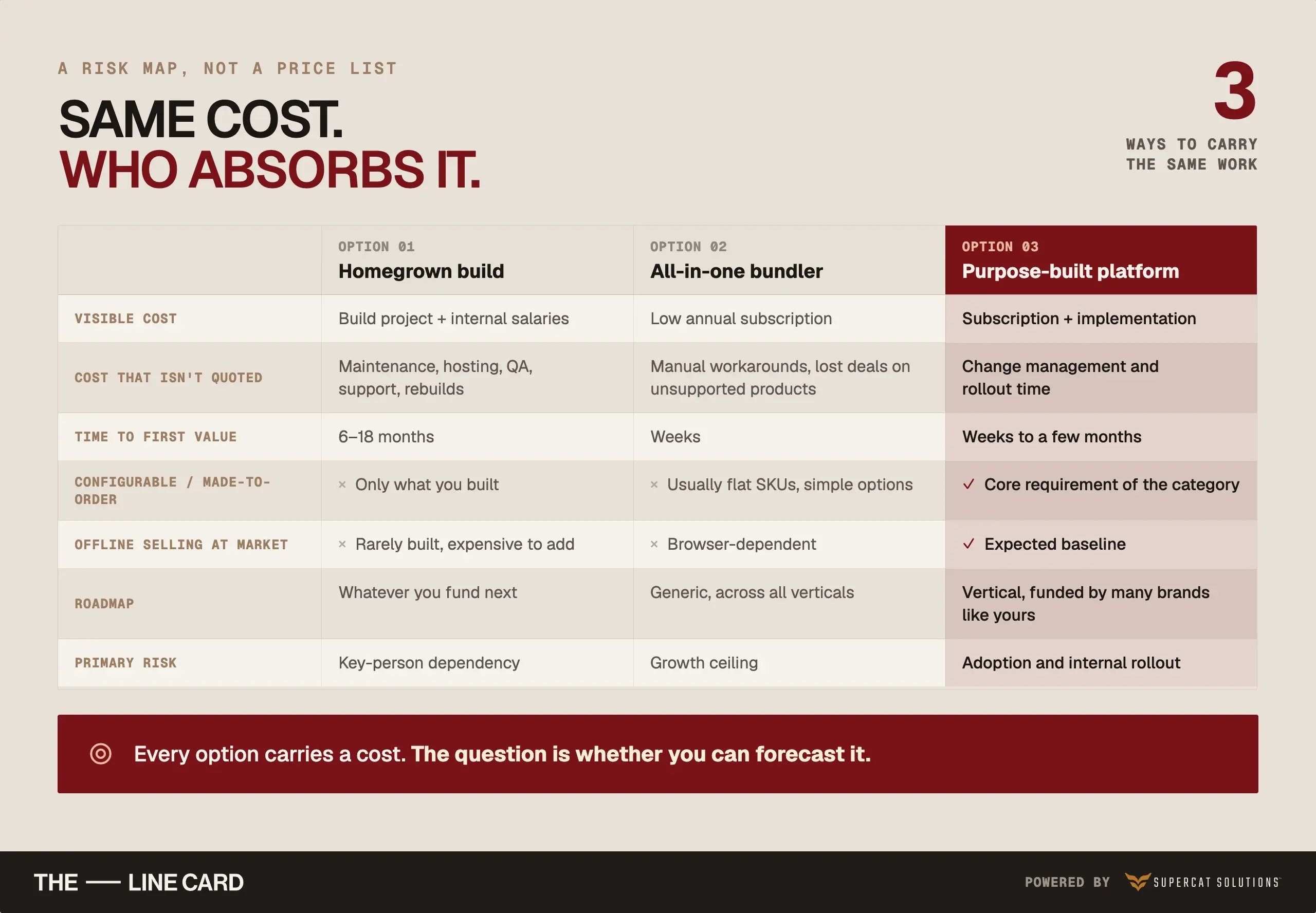
Read that as a risk map, not a price list. Every option carries a cost. The question is whether you can forecast it.
Why homegrown sales tools look cheaper than they are
Homegrown tools look cheaper because you quote the build once and pay for maintenance forever, and only the first number enters the comparison. Decades of software engineering research point the same way: across a system's life, ongoing maintenance and modification consistently consume more than the original development, with peer-reviewed estimates placing maintenance well above half of total lifecycle cost.
A new collection launches with an option structure the data model does not support. The ERP is upgraded and the sync breaks. Tariffs move, and pricing needs a scenario the tool cannot express. iPadOS updates, and the app needs recertifying. None of it is large; all of it is mandatory. Together, they form a permanent internal tax that was never in the business case, and it comes due around Market, when engineering attention is scarcest, and data errors are most expensive.
The standard objections are worth taking seriously, because each contains something true: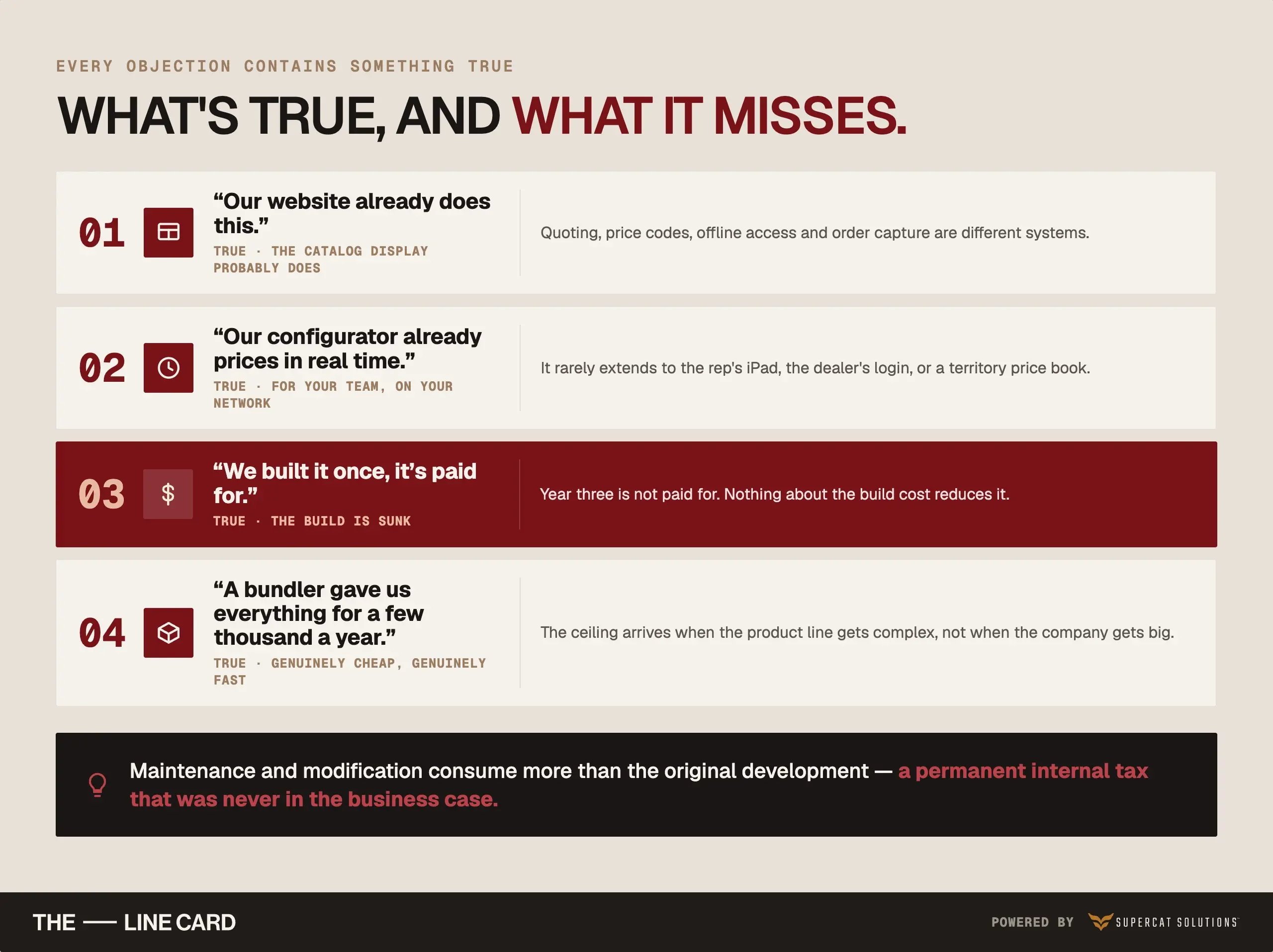
Why engineering time and feature lag are the highest hidden costs
The highest cost of a homegrown tool is what engineering does not build because of it, and how far the tool drifts behind the market while that happens. Both costs are invisible in a budget and visible in every meeting where a rep says "let me check on that."
Feature lag compounds quietly. Dealer self-service, real-time inventory, configurable presentation, instant quote documents, offline access on the show floor and now AI-assisted product discovery are no longer differentiators. They are what an independent rep carrying eight to twelve lines sees on the best tool in their bag, daily. An internal tool cannot track that curve, because every capability competes for funding against actual product development. A platform serving many brands in one vertical amortizes the same work across them all.
There is a clean test for the opportunity cost. If the tool you are building is not something you would ever sell to another brand. Buy overhead at the lowest defensible total cost, not build it at the highest. Key-person risk belongs in the same line: most internal sales tools are the work of one or two people, and when they leave, the documentation gap becomes a rebuild quoted as a new project.
Where all-in-one bundlers break in furniture and lighting
Bundlers break at product complexity. For a brand with a flat SKU list, one price book, and a simple dealer motion, the value is real — a live site, a storefront, and a basic rep view in weeks, for a fraction of a platform subscription.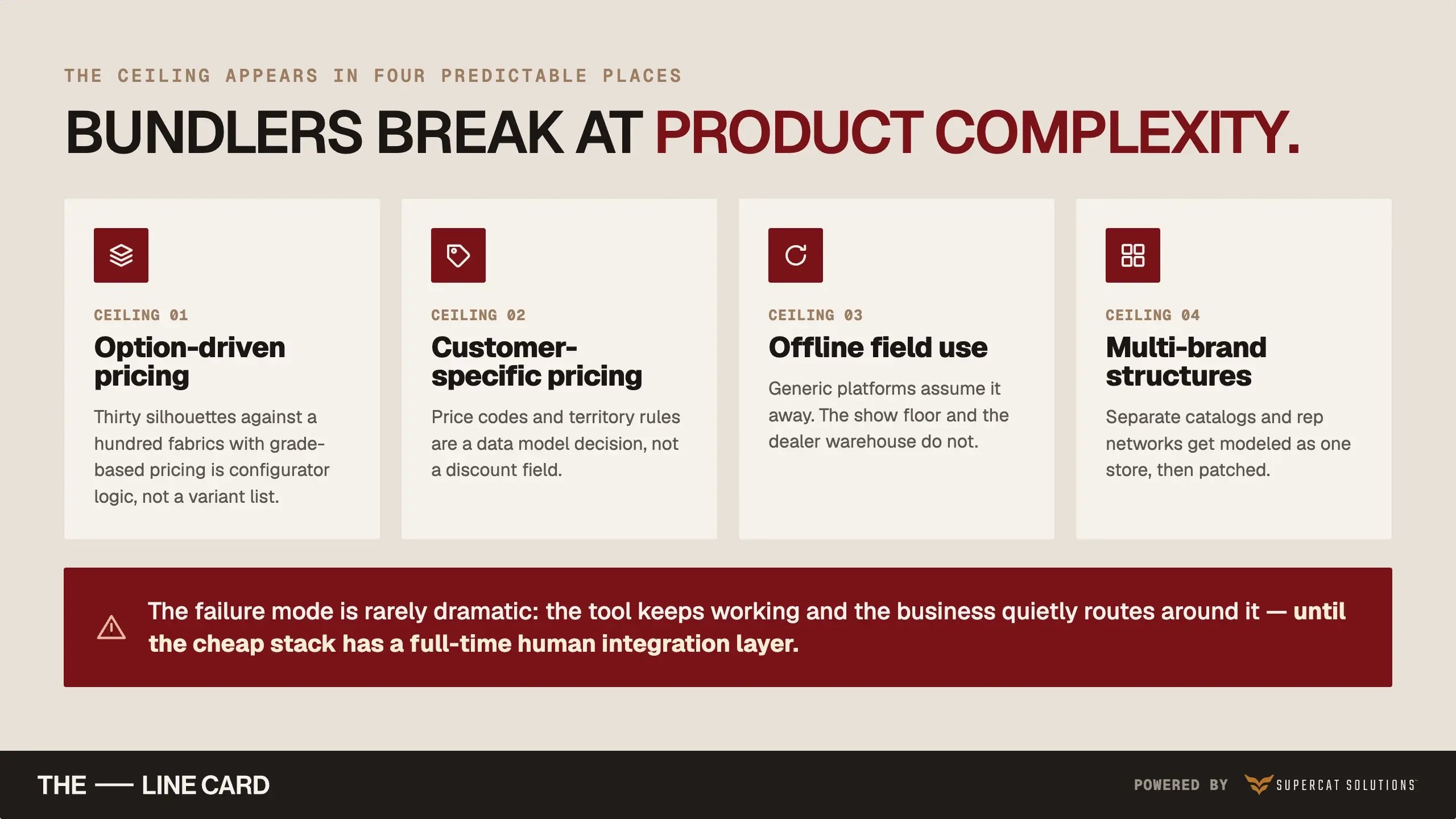
The ceiling appears in four predictable places: option-driven pricing, where thirty silhouettes against a hundred fabrics with grade-based pricing is configurator logic rather than a variant list; customer-specific pricing, where price codes and territory rules are a data model decision, not a discount field; offline field use, which generic platforms assume away; and multi-brand structures, where separate catalogs and rep networks get modeled as one store, then patched.
The failure mode is rarely dramatic. The tool keeps working, and the business quietly routes around it. Someone maintains a fabric-grade spreadsheet. Someone re-keys orders into the ERP. The cheap stack has acquired a full-time human integration layer. That cost is paid in salaries rather than software, which is exactly why it stays out of the comparison.
When building in-house is the right decision
Building in-house is right when the tool encodes something competitors genuinely cannot copy, and when you can fund it permanently rather than once. Three conditions should all hold:
- It is a differentiator, not a utility. A proprietary configurator that reflects a manufacturing process nobody else runs is worth owning. A quote PDF generator is not.
- You have engineering capacity for the decade. Not a contractor for the build — a team for the life of the tool.
- Your data model has no market analogue. If nothing on the market can model how your products work, building may be the shorter path.
A middle position is frequently overlooked: buy the platform and build only the differentiated layer on top of it through integration. That keeps engineering pointed at the part of the stack that is actually yours.
Five questions to ask before you build a sales tool in-house
You can answer these five questions in one meeting and surface the real total cost of ownership faster than a vendor comparison. Ask them about the tool you are considering or the one you already run.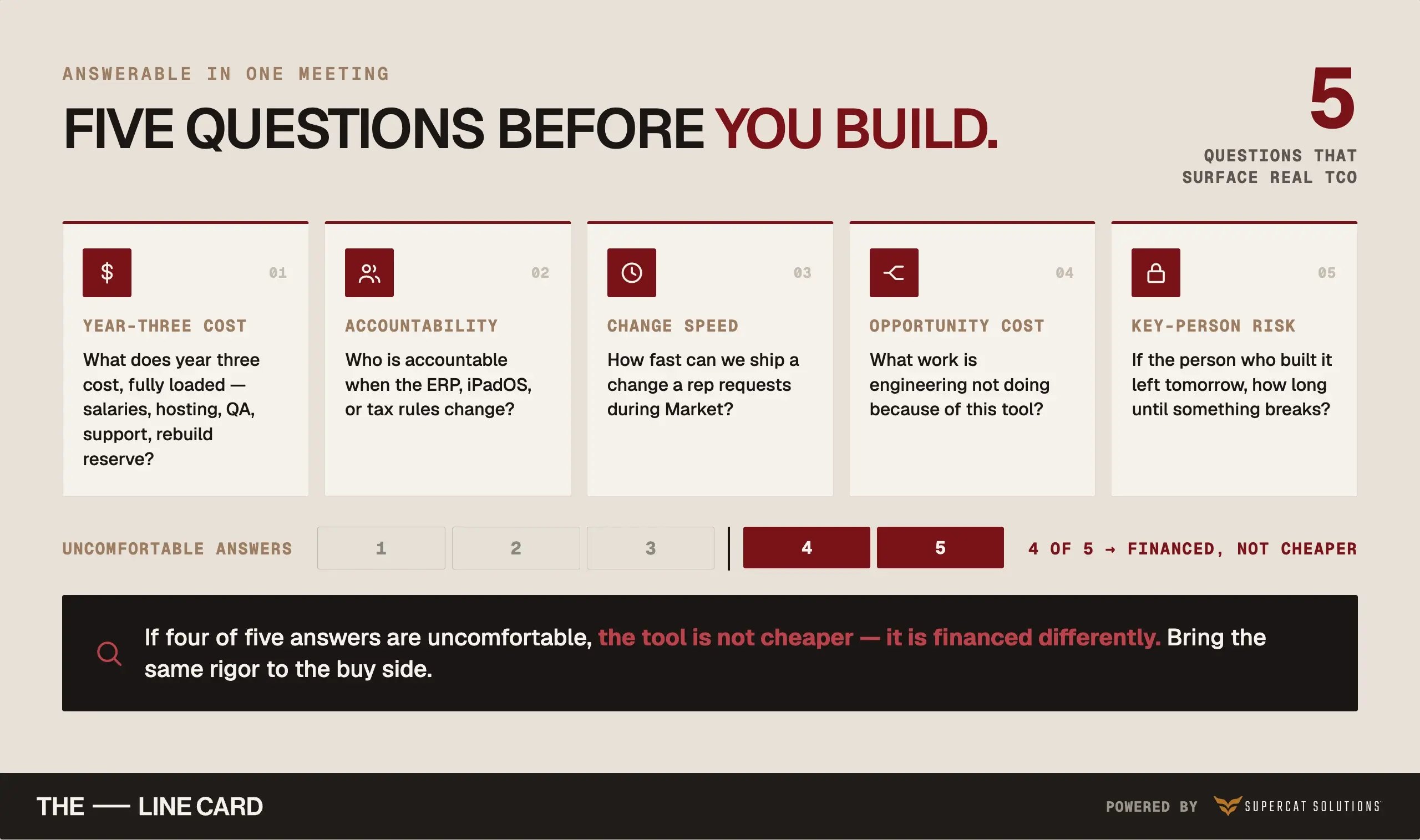
If four of five answers are uncomfortable, the tool is not cheaper, it is financed differently. Bring the same rigor to the buy side: implementation effort, data-ownership boundaries, and who keeps product data clean decide whether a purchased platform delivers.
How purpose-built platforms change the cost equation
Purpose-built platforms change the equation by converting an open-ended internal liability into a forecastable operating cost, and by spreading category-specific development across every brand using it. Those economics only work in a narrow vertical, which is why general-purpose B2B commerce tools rarely solve furniture and lighting cleanly.
That infrastructure has to cover the same things across the category. Treat the list below as a scope check on a build, not a feature list:
- A field application that works offline. Full catalog access, product configuration and quoting on the show floor or in a dealer's warehouse, with no assumption of signal, and a sync that resolves cleanly when the connection returns.
- A browser-based catalog for dealers and designers. Self-service exploration, specification and reordering against each account's own pricing, available at 2 a.m. without a rep in the loop.
- A partner layer. One place holding current assets, marketing materials, order status and account history, so the answer to "can you send me that" is a link rather than an email thread.
- A central administrative console. The control point where catalogs, pricing rules, media, specifications and user access are governed once and propagate everywhere else.
A manufacturer could build all four. The question is whether building all four a second time (and then maintaining them separately) is the best use of the same money and the same engineers, and whether your version will still be current in 2029. The pattern matches what shows up across sales maturity in this industry and in the State of Furniture & Lighting Sales Execution 2026 report: companies lose to the compounding cost of maintaining a worse one.
What the honest build-vs-buy math usually shows
The honest math usually shows a homegrown tool is the same cost, unbudgeted, paid in internal capacity rather than subscription. That is not an argument against building. It is an argument against comparing a build quote to a subscription price and calling it analysis.
Brands that get this right do three things: they price year three rather than year one, they separate what is genuinely differentiated from what is category plumbing, and they ask what their engineers would otherwise be building. That last answer, more than any feature comparison, is what the decision actually costs, and the operational pressures driving it are not easing.